The short answer
Choose a connector by asking why the joint needs to separate at all. Every connector is a deliberately engineered break in a circuit — added to make a product easier to build, test and service, and paid for in cost and reliability. Once you know how often it separates, in whose hands, and in what conditions, the family usually chooses itself: the signal type narrows it to a handful of candidates, and the environment and mating-cycle requirement pick the winner.
- Match the family to what's carried: power, signal, RF, data and fibre each have their own connector types
- Check the mating-cycle rating — a service connector and a daily-use connector are different parts
- Gold-plated contacts for low-level signals and frequent mating; tin is fine for power and set-and-forget joints
- Harsh environments need IP ratings, positive locking, and housings rated for the conditions
- Panel-mount and PCB-mount variants of the same family are usually not interchangeable — check the mating interface
Connectors are the most varied category in electronics — Rapid alone stocks over 9,000 lines — and mis-specifying one is among the most common causes of rework, intermittent faults and field returns. This guide explains how to narrow the range down quickly: what a connector actually buys you, the questions that scope the selection, and an application-by-application map of the connector families in Rapid's range.
What is a connector?
An electrical connector joins two or more circuits in a way that can be separated again without cutting or permanently altering either side. At its simplest it's a plug — the male part carrying pins — and a socket or receptacle that receives them. In practice, connectors vary enormously in size, pin count, locking mechanism, contact plating and environmental rating, because they exist to solve very different problems.
And the problems they solve are mostly about people, not electrons. Electrically, a soldered joint beats a connector every time — lower resistance, no fretting, nothing to work loose. Connectors earn their place by letting equipment be built in sections, tested independently, installed by someone other than the manufacturer, and serviced without a soldering iron. That's the trade at the heart of every specification: you're buying manufacturability and serviceability, and paying in cost, size and a potential failure point. A well-specified connector makes that trade invisibly; a poorly specified one is where the intermittent fault lives.
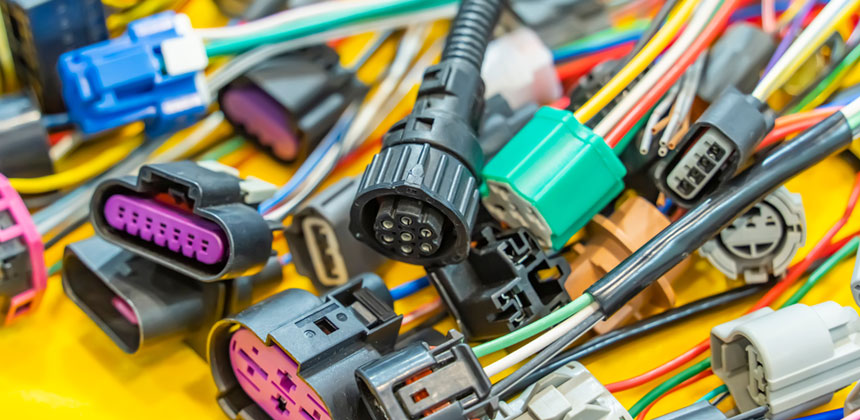
Rapid's range covers audio, RF, power, circular industrial, heavy duty, D-type, wire-to-board, board-to-board, automotive, USB, fibre optic and crimp termination families, from brands including Neutrik, Bulgin, TruConnect, Phoenix Contact, JST, Amphenol and HARTING.
How do you narrow down the choice?
Start with what the joint carries. Power, low-level signal, differential data, RF and fibre each have their own connector families, and they don't substitute for one another — a connector optimised for audio has the wrong impedance behaviour for RF, and a power connector's contacts are the wrong geometry for a data signal. This one question typically cuts 9,000 lines down to a few hundred.
Then ask how often it separates, and in whose hands. Every connector carries a mating-cycle rating, and the spread is enormous: a board-to-board header may be rated for a few dozen insertions across its whole life, while a USB-C receptacle is rated for ten thousand. A joint that separates once at installation, a service connector opened every few years, and a user-facing port cycled daily are three different specifications wearing the same name. This is also where contact plating enters: gold-plated contacts maintain a reliable low-resistance interface for low-level signals and repeated mating, while tin is perfectly adequate — and cheaper — for power connections and joints that mate once and stay put. The failure mode to know about is fretting: tin contacts subjected to vibration micro-slide against each other, build up oxide, and turn into intermittent faults that vanish the moment anyone touches the loom.
Match the mating interface. Cable-to-cable, cable-to-panel, wire-to-board and board-to-board are distinct configurations, and panel-mount and PCB-mount variants within the same family are usually not interchangeable. Specify both halves of the connection together — the connector and its counterpart are one decision, not two.
Check the environment. Indoor equipment opens up nearly the whole range. Outdoor, wet, dusty or high-vibration installations demand IP-rated, positively locking connectors — the natural territory of circular industrial and sealed automotive families — with housing materials chosen for UV, temperature and chemical exposure. Check the IP rating in both mated and unmated states; some connectors are only sealed when plugged in.
Count the pins last, with a margin. Pin count is rarely the hard constraint the other factors are, and many families offer the same shell across a range of counts. If the design might grow, choosing a family with headroom now is far cheaper than changing connector systems later.
Which connector family fits which application?
| Application |
Connector family |
Key consideration |
| Professional balanced audio |
XLR |
Pin count (3, 4 or 5); cable or chassis mount; locking type |
| Headphones, instruments, line-level audio |
Jack plugs and sockets |
Size (3.5mm or 6.35mm); TS or TRS; switched or unswitched |
| Consumer audio/video interconnects |
RCA phono |
Channels; gold or standard plating; cable or chassis mount |
| Antenna and RF signal routing |
Coaxial / RF |
Series (SMA, BNC, N-type); impedance (50Ω/75Ω); frequency range |
| Mains power inlet/outlet on equipment |
IEC mains inlets and outlets |
IEC type (C13/C14/C19/C20); current rating; fused or unfused |
| Low-voltage DC power |
DC power connectors |
Barrel inner/outer diameter; current rating; locking or not |
| Industrial sensors and actuators |
Circular industrial connectors |
Shell size; pin count; IP rating; M8 or M12; locking style |
| Heavy-duty industrial field wiring |
Heavy duty connectors |
Frame and insert configuration; contact rating; housing material |
| Serial data, legacy instrumentation |
D-type (D-sub) |
Pin count (9/15/25/37); solder, crimp or PCB termination; backshell |
| PCB-to-wire and internal looms |
Wire to board |
Pitch; pin count; crimp or IDC; polarisation key |
| Board-to-board interconnection |
Board to board |
Pitch; stacking height; right-angle or vertical |
| Flat flexible cable (FFC/FPC) |
FFC and FPC |
Pitch (0.5mm, 1mm); conductor count; ZIF or non-ZIF |
| USB device and host connections |
USB and Firewire |
USB generation; connector type (A/B/C/Micro/Mini); mount style |
| Wire crimping and in-line termination |
Crimps, splices and terminals |
Conductor cross-section; insulated or not; terminal type |
| High-speed optical data |
Fibre optic connectors |
Format (LC/SC/ST/FC); single- or multi-mode; polish type |
| Automotive wiring and harness repair |
Automotive connectors |
Series compatibility; sealed or unsealed; terminal size |
How is Rapid's connector range organised?
For browsing rather than searching, the range is grouped by domain. Signal work lives under audio and video — XLR, jack, RCA phono and DIN types together — and RF, which gathers the coaxial families with their adaptors and accessories. Power splits between power connectors, covering IEC mains inlets, battery and heavy-duty power types, and the dedicated DC power category for barrel jacks and plugs.
Industrial and vehicle applications are served by circular (industrial, mil-spec and sealed types), heavy duty modular systems and automotive connectors. At board level, wire to board, board to board, FFC and FPC and the crimps, splices and terminals ranges cover everything inside the box. Data and comms round out the range with USB and Firewire, modular RJ types for networking and telephony, fibre optic, and D-type — plus test clips and connectors for the bench.
Which brands does Rapid stock?
Neutrik is the benchmark in professional audio — its XX-series XLRs, speakON loudspeaker connectors and powerCON mains connectors are the parts a touring rig expects to see. Bulgin specialises in environmental sealing; the Buccaneer circular range offers IP68 ratings and locking mechanisms built for outdoor, marine and industrial conditions where ordinary connectors fail. HARTING's Han series leads the heavy-duty industrial field, widely specified in machinery, robotics and power distribution.
Phoenix Contact brings particular strength in industrial automation interfaces across PCB-mount and panel-mount types; JST covers compact, fine-pitch wire-to-board and board-to-board systems found inside most OEM and consumer equipment; and Amphenol spans a broad portfolio across circular, RF and heavy-duty families. TruConnect — Rapid's own brand — offers cost-effective general-purpose connectors, terminals and D-types suited to prototyping through to volume production.
Ordering and despatch: high-volume connector lines across all major families are ready to order, with same-day despatch on UK-stocked items and delivery within a week for extended-range stock. Contact Rapid to discuss options on specialist items.
Browse over 9,000 connector lines across audio, RF, power, circular, industrial and more.
Shop all connectors
Frequently asked questions
What is the difference between a plug and a socket?
A plug is the male part, carrying pins that insert into the mating half; a socket or receptacle is the female part that receives them. Some families complicate this: in RF connectors, "plug" usually means the cable-mounted part regardless of whether its centre contact is a pin or a socket.
Should I choose gold or tin contact plating?
Gold for low-level signals, frequent mating, or anything exposed to vibration — it maintains a stable low-resistance interface indefinitely. Tin is adequate and cheaper for power connections and joints that mate once and stay put, but tin contacts in vibrating environments can develop intermittent faults through fretting corrosion.
What should I check for a harsh or outdoor environment?
The IP rating in both mated and unmated states, a positive locking mechanism, the operating temperature range, and UV stability of the housing. Circular industrial connectors and sealed automotive types are designed for this; standard audio and D-type connectors generally are not.
What is the difference between a circular connector and a D-type connector?
Circular connectors have a round shell with a rotary or push-pull lock — mechanically robust, vibration-resistant, and often environmentally sealed, suiting industrial and outdoor use. D-type connectors use a polarised D-shaped metal shell providing orientation and some shielding, and remain standard for serial data and instrumentation interfaces indoors.
Related categories
Cable assemblies ·
Cables and wires ·
Terminal blocks ·
Cable accessories ·
Enclosures ·
Soldering


 {{SessionBasket.ItemCount }}
