The short answer
A terminal block is chosen on five parameters: pitch, current and voltage rating, conductor cross-section, pole count, and connection method. Pitch is the unforgiving one — it must match the PCB footprint or mating part exactly. The connection method is the interesting one, because a terminal is a mechanical joint that has to survive years of vibration and thermal cycling, and screw and spring clamps age very differently.
- PCB and pluggable types: confirm pitch first — there's no flexibility once the board is laid out
- Rate current and voltage above worst case, with derating for warm panels
- Fine-stranded conductors in screw clamps want bootlace ferrules
- Screwless/push-in blocks hold their clamping force without maintenance; screw clamps may need periodic retorquing
- Standardise on one manufacturer per panel — accessories rarely interchange
Terminal blocks are the most ubiquitous component in panel building and among the most commonly mis-specified — a wrong pitch, an undersized rating, or a clamp that doesn't suit the conductor all surface as rework, and the last one can surface as a field failure years later. This guide covers what a terminal block is, the five specifications that matter, the screw-versus-screwless question properly, and which of Rapid's terminal block categories fits which job.
What is a terminal block?
A terminal block — also called a terminal connector or terminal strip — is a modular, insulated component that provides a secure, serviceable point to connect two or more conductors. Instead of soldering wires together or relying on field-made crimps, a terminal block gives you a termination that can be inspected, tested, disconnected and re-made — which is why they're the backbone of control panels, industrial installations and any product designed to be maintained rather than thrown away.
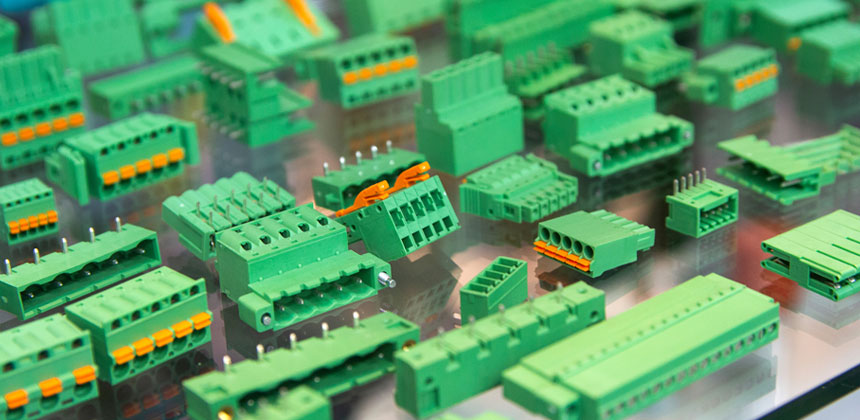
They come in three broad mounting formats: blocks that snap onto 35mm DIN rail inside a panel, blocks that solder directly onto a PCB, and two-part pluggable systems where field wiring terminates into a removable plug. The right one depends on where the connection lives and who will need to touch it later.
How do you specify a terminal block?
Confirm the pitch first. Pitch is the centre-to-centre distance between poles — 2.54mm, 3.5mm, 5mm and 7.62mm are the common values. On PCB-mount and pluggable types it must match the board footprint exactly, and since the board layout is fixed long before parts are ordered, pitch is the one specification with zero tolerance for approximation. Check it against the datasheet, not the photograph.
Rate for the worst case, then derate. Blocks are rated for maximum continuous current — anywhere from 8A on compact PCB types to 125A and beyond on distribution blocks — and a maximum working voltage. Both should comfortably exceed your worst-case circuit values, and the current figure deserves derating in a sealed or densely populated panel, where ambient temperature inside the enclosure can sit well above the room.
Match the clamp to the conductor. Acceptance range is quoted in mm², and the clamping mechanism must suit both the smallest and largest conductor it will see. The detail that catches people out is conductor construction: solid and fine-stranded wire behave differently in a clamp, and fine-stranded conductors in screw terminals should be fitted with bootlace ferrules to stop individual strands escaping the clamp and to give the screw something solid to bite on.
Count the poles — and decide whether the count is final. Fixed multi-way blocks are compact and tidy where the circuit is settled. DIN rail blocks ganged as individual units cost a little more space but let the panel grow, and in practice panels always grow. If in doubt, go modular and fit an extra end bracket.
Choose the connection method last — it's important enough to get its own section.
Screw or screwless: which connection method should you choose?
This is usually presented as a speed question — screwless is faster to wire — but the more important difference is what happens to the joint over the following decade. Copper creeps: under constant clamping pressure the conductor slowly deforms and the joint relaxes. A screw clamp's contact force comes from its installed torque, so as the copper relaxes, the force drops — which is why maintenance regimes for screw-terminated panels include periodic retorquing, and why loose screw terminals are a classic cause of intermittent faults and hot joints. A spring clamp's force comes from the spring itself, which follows the conductor as it relaxes and holds contact pressure indefinitely, tool-free and torque-free. That's the real reason push-in and cage clamp systems dominate automation panels and anything subject to vibration.
None of which makes screw clamps obsolete. They accept any conductor construction without fuss, need no special release tool, allow a fitter to feel and verify the termination, and remain the expected standard in much electrical installation and maintenance practice — an unfamiliar release mechanism is its own reliability risk when the person servicing the panel in ten years has never seen one. Screw blocks also tend to be cheaper like-for-like. If the panel will live somewhere benign and be maintained by general electricians, screw clamps are a perfectly good answer; if it's high-volume production wiring or a vibrating environment, screwless earns its premium.
| Feature |
Screw clamp |
Screwless / push-in |
| Contact force over time |
Relies on installed torque; may need retorquing |
Spring maintains force as the conductor relaxes |
| Vibration resistance |
Good |
Excellent |
| Wiring speed |
Standard |
Significantly faster in volume |
| Tooling |
Screwdriver |
None for solid conductors; release tool or lever to remove |
| Wire preparation |
Stripped conductor; ferrule for fine-stranded |
Stripped solid conductor; ferrule recommended for fine-stranded |
| Typical brands |
Phoenix Contact, TruConnect, CamdenBoss |
WAGO (CAGE CLAMP®), Phoenix Contact push-in series |
Which terminal block type do you need?
Building a control panel? DIN rail mount terminal blocks are the standard: individual units ganged along 35mm rail, expandable as the panel grows. Where field wiring meets a PLC or I/O card, terminal block interface modules put the whole interface on the rail in one pre-wired unit rather than a forest of individual terminals. Power comes into the panel through distribution blocks — high-current blocks that split a single feed into multiple protected ways — and circuits that need individual protection can use fused terminal blocks with integral fuse holders, saving a separate fuseholder row. Terminal block accessories — end brackets, jumper bars, end covers and markers — turn the row of blocks into a finished, labelled assembly, and they're the reason to standardise on one manufacturer per panel: they rarely interchange between brands.
Designing a product? PCB mount terminal blocks solder directly to the board in through-hole or SMD form across the full range of pitches. Where the wiring needs to disconnect for installation, test or service, plugs and headers split the connection in two: a board-mounted header and a removable plug that can be wired and tested on the bench before it ever meets the product. For OEM equipment that gets installed by someone else, pluggable is almost always worth the small premium.
Wiring something simpler? Barrier strips — traditional screw strips with insulating walls between poles — remain a cost-effective answer for straightforward panel and chassis wiring, and the wider terminal strips and connector blocks category covers standard connector strips alongside the fused and barrier types.
Which brands does Rapid stock?
WAGO leads the screwless field — its CAGE CLAMP® system is the reference point for tool-free termination, spanning DIN rail and PCB types with deep accessory support. Phoenix Contact offers one of the broadest ranges available in both screw and push-in forms, from compact 2.54mm PCB blocks to heavy-duty rail blocks for large cross-sections. CamdenBoss's CamBlock range covers general-purpose PCB-mount and pluggable blocks at competitive prices for OEM builds, and TruConnect — Rapid's own brand — provides cost-effective interlocking and stackable types suited to high-volume production where the specification is straightforward.
Ordering and despatch: high-volume lines across the WAGO, Phoenix Contact, TruConnect and CamdenBoss ranges are ready to order, with same-day despatch on UK-stocked items and delivery within a week for extended-range stock. Contact Rapid to discuss options on specialist items.
Frequently asked questions
What is pitch on a terminal block?
Pitch is the centre-to-centre distance between adjacent poles, measured in millimetres — commonly 2.54mm, 3.5mm, 5mm or 7.62mm. On PCB-mount and pluggable types it must match the board footprint exactly, so confirm it from the datasheet before ordering; the layout offers no flexibility once fixed.
Do I need ferrules on stranded wire?
For fine-stranded conductors in screw clamps, yes — a bootlace ferrule binds the strands so none escape the clamp and gives the screw a solid surface to grip. Ferrules are also recommended for fine-stranded wire in push-in blocks. Solid conductors don't need them.
Can I mix terminal blocks from different manufacturers on the same DIN rail?
Usually, yes — provided they share the same rail profile. The catch is accessories: end brackets, jumper bars, covers and markers are brand-specific and rarely interchange. If a panel uses accessories at all, standardise on one manufacturer's range within it.
What is a pluggable terminal block?
A two-part system: a fixed header, usually PCB-mounted, and a removable plug into which the conductors terminate. Wiring can be completed and tested on the plug before mating, and equipment disconnects from field wiring in seconds without disturbing individual conductors. Browse them under plugs and headers.
Related categories
Terminal strips and connector blocks ·
DIN rails and accessories ·
Crimps, splices and terminals ·
Cable accessories ·
Enclosures ·
Connectors


 {{SessionBasket.ItemCount }}
