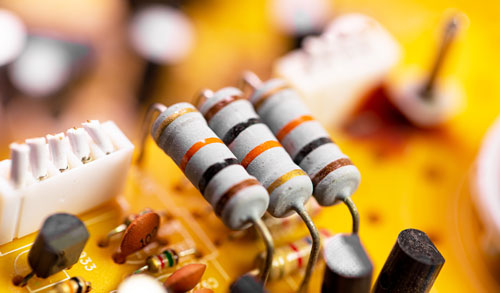
In every industrial electronic system, resistors play a foundational role. These passive components are essential for controlling current, dividing voltage, and protecting sensitive devices from overload. Whether you're designing a power supply, motor controller, or sensor interface, resistors help ensure stable, predictable performance across a wide range of applications.
For design engineers, understanding how resistors function and how to select the right type is key to building reliable and efficient circuits.
What do resistors do?
A resistor limits the flow of electrical current in a circuit. It does this by converting electrical energy into heat, based on its resistance value measured in ohms (Ω). Resistors are used to:
- Control current to LEDs, transistors, and ICs
- Divide voltage across components
- Set biasing conditions in amplifiers
- Filter signals in analog circuits
- Provide pull-up or pull-down logic levels in digital systems
In industrial environments, resistors are found in control panels, automation systems, instrumentation, and power electronics. Their reliability and precision directly impact the performance and safety of the overall system.
How do resistors provide stability in industrial electronic systems?
In industrial environments, resistors stabilise electronics by providing precise current limiting and voltage division, which prevents fluctuations from damaging sensitive controllers. By establishing consistent biasing and logic levels, they make automated systems and motor drives operate within safe, predictable parameters despite electrical noise or environmental stress.
How do resistors protect sensitive industrial components from electrical overload?
Resistors act as a primary line of defence by converting excess electrical energy into heat, effectively limiting the current that reaches vulnerable semiconductors like ICs and transistors. By maintaining specific pull-up or pull-down logic levels, they also prevent "floating" signals that could cause erratic behaviour or system-wide failure in digital logic controllers.
Types of resistors and their applications
Resistors come in various types, each suited to specific tasks:
1. Carbon Film and Metal Film Resistors
These are common in general-purpose electronics. Metal film resistors offer better accuracy and temperature stability, making them ideal for precision circuits.
2. Wirewound Resistors
Used in high-power applications, wirewound resistors can handle significant current and heat. They’re often found in motor drives, power supplies, and industrial heaters.
3. Surface-Mount Resistors (SMD)
Compact and efficient, SMD resistors are used in densely packed PCBs, especially in automation and control systems.
4. Variable Resistors (Potentiometers)
These allow manual adjustment of resistance, useful in calibration, tuning, and user interfaces.
Selecting a resistor
When selecting a resistor, engineers must consider resistance value, tolerance, power rating, temperature coefficient, and physical size. In harsh environments, factors like vibration, humidity, and thermal cycling also influence component choice.
Best practices for industrial design
To ensure long-term reliability in industrial applications:
- Use resistors with appropriate power ratings to avoid overheating
- Select tight tolerance values for precision circuits
- Consider derating in high-temperature environments
- Verify compliance with standards such as RoHS or UL where required
- Document part numbers and specifications clearly for procurement and maintenance teams
Design engineers should also plan for obsolescence by choosing widely available resistor types and maintaining cross-reference lists for alternative suppliers.
Get yours
Resistors are small but essential components in industrial electronics, providing control, protection, and stability across countless applications. For design engineers, selecting the right resistor type and rating is critical to building circuits that perform reliably under demanding conditions.
Browse full range