We use cookies on our website to ensure you get the best possible experience – they allow us to tailor content specifically to you, analyse our website to help make improvements, and display ads that are applicable to you across other websites. If you’re happy with this, please select “Allow all", or personalise the cookies you allow with “Manage”. Clicking on “Reject non-essential” will remove these cookies, but the site may not function to its best abilities. For more information, please visit our cookie policy
Single board computers in 2026: what to choose and why it matters
Published on 17 April 26
Single board computers (SBCs) have evolved far beyond hobbyist tools. In 2026, they sit at the heart of industrial automation, edge AI, robotics and smart devices - offering a powerful combination of compact size, low power consumption and increasingly advanced processing capabilities.
Now with more choice than ever, selecting the right SBC is no longer straightforward.
This guide cuts through the noise - focusing on real-world use cases, practical trade-offs and what actually matters when choosing a single board computer today.
What are single-board computers?
Single board computers are considered complete computers built onto a single circuit board, typically including:
Processor (CPU or SoC)
Memory (RAM)
Storage (eMMC or microSD)
Connectivity (USB, Wi-Fi, Bluetooth, Ethernet)
GPIO (for hardware interaction)
Unlike traditional PCs, SBCs are designed for embedded applications, where size, efficiency and integration are critical.
What’s changed in SBCs by 2026?
The biggest shift isn’t just more power - it’s how SBCs are being used.
1. Edge AI is now standard
Modern SBCs increasingly support:
Machine vision
Audio recognition
On-device AI inference
This reduces reliance on cloud processing, improving speed and privacy.
Why is edge AI becoming a standard feature for single board computers?
Modern SBCs are increasingly equipped with dedicated neural processing units (NPUs) or high-performance SoCs that allow for on-device AI inference. This shift toward edge AI enables robots and industrial sensors to process machine vision and audio recognition locally, significantly reducing latency, lowering bandwidth costs and improving data privacy by removing the need for constant cloud connectivity.
2. Hybrid architectures are emerging
A major trend is combining:
High-level OS processing (Linux)
Real-time microcontroller control
This allows developers to run complex applications and handle time-critical tasks on a single board.
3. Better connectivity and integration
Expect:
Faster wireless (Wi-Fi 5/6, Bluetooth 5+)
More expansion options
Easier integration with sensors, cameras and industrial systems
Choosing the right SBC: key considerations
Before picking a board, focus on the application - not just specs.
Processing power vs real-time control
Linux SBCs are great for complex tasks
Microcontrollers excel at real-time response
Hybrid boards now offer both
Memory and storage
2GB–4GB RAM is now a practical baseline
Onboard eMMC improves reliability over SD cards
Connectivity
Built-in Wi-Fi and Bluetooth reduce system complexity
Industrial use may require Ethernet or fieldbus support
Expansion and ecosystem
GPIO compatibility
Sensor integration (e.g. QWIIC, I2C, SPI)
Software support and community
Where SBCs are used in 2026
Modern SBCs are no longer limited to prototyping.
Industrial automation
Machine monitoring
Predictive maintenance
Edge data processing
Robotics
Motor control and AI vision
Autonomous navigation
Smart devices and IoT
Home automation hubs
Environmental monitoring
Connected consumer products
Education and development
Teaching programming and electronics
Rapid prototyping
The rise of hybrid SBC platforms
One of the most significant developments in recent years is the emergence of hybrid SBCs - platforms that combine a Linux processor with a microcontroller on a single board.
Instead of forcing a choice between a full operating system and precise real-time control, these systems enable both to run in parallel.
This allows developers to:
Run Linux applications (Python, AI models, networking)
Execute real-time control (sensors, motors, timing-critical tasks)
Seamlessly bridge communication between both layers
As a result, hybrid SBCs are particularly well suited to:
Arduino has traditionally been associated with microcontrollers, but its newer platforms reflect the shift toward more integrated, high-performance systems.
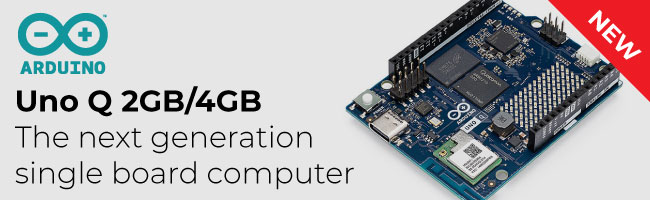
Boards like the Arduino UNO Q are a good example of hybrid design in practice, combining:
Arm-based Linux processing
A dedicated microcontroller for real-time tasks
Built-in wireless connectivity
Unified development workflows
This makes it easier for developers to work across both environments - combining Arduino sketches with Python or AI models, while keeping real-time and high-level processing tightly integrated.
Rather than replacing traditional SBCs, platforms like this are helping bridge the gap between embedded control and full computing.
When to choose a hybrid SBC
A hybrid board is a strong choice if your project needs:
Real-time control and high-level processing
AI or machine learning at the edge
Integration of multiple systems (sensors, cameras, actuators)
Reduced system complexity (fewer separate boards)
What are the advantages of hybrid single board computers?
A hybrid single board computer combines the high-level processing power of a Linux-based CPU with the precise, real-time response of a microcontroller on a single board. This lets developers run complex Python scripts or AI models in the OS layer while simultaneously executing time-critical tasks, such as motor control or sensor polling, without the jitter or lag often associated with standard operating systems.
Common mistakes when choosing an SBC
Even experienced users can fall into these traps:
Choosing based on specs alone – higher specs don’t always mean better performance for your use case.
Ignoring real-time requirements – Linux-based systems are not ideal for precise timing without additional support.
Overlooking power and thermal constraints – more powerful boards often require better cooling and power management.
Underestimating the software ecosystem – good hardware with poor support slows development significantly.
What are the key thermal and power considerations for 2026 single board computers?
As single board computers become more powerful, they often generate significant heat and require careful power management. High-performance boards used in industrial automation or edge AI typically need active cooling (fans) or large passive heatsinks to prevent thermal throttling, alongside a stable power supply that can handle the sudden current spikes required during intensive AI processing.
Quick comparison: SBC vs microcontroller vs hybrid
Feature
SBC (Linux)
Microcontroller
Hybrid SBC
Processing power
High
Low–moderate
High
Real-time control
Limited
Excellent
Excellent
OS support
Full Linux
None
Linux + RTOS/firmware
Complexity
Moderate
Low
Moderate
Best use case
AI, apps, IoT
Control systems
Integrated smart systems
Looking for a deeper breakdown? Read our full guide comparing microcontrollers and single-board computers, including use cases, pros and cons, and how to choose the right platform for your project.
Final thoughts: SBCs are becoming complete systems
In 2026, single board computers are no longer just small computers - they’re complete embedded platforms capable of handling everything from control logic to AI processing.
The biggest shift is not just performance, but integration:
Fewer separate components
More capable boards
Faster development cycles
For many applications, especially in automation and smart systems, hybrid platforms like the Arduino UNO Q highlight where the market is heading.


 {{SessionBasket.ItemCount }}