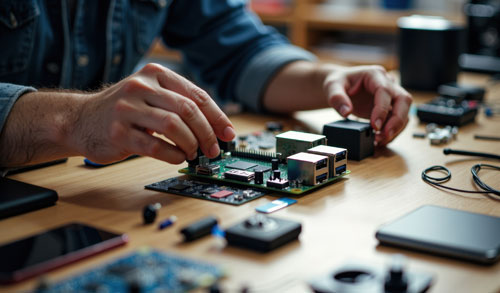
When starting a new electronics or IoT project, one of the first decisions you’ll face is whether to use a microcontroller or a single-board computer (SBC). Both are powerful tools, but they serve different purposes. Choosing the right one can save you time, money, and frustration. This guide explains what each is, their key differences, pros and cons, and how to decide which is best for your project.
What is a microcontroller?
A microcontroller is a compact integrated circuit designed to perform specific tasks. It typically includes a processor, memory, and input/output peripherals on a single chip. Microcontrollers are ideal for simple, dedicated functions like reading sensors, controlling motors, or managing small devices.
Common examples:
- Arduino boards (ATmega series) - Popular among hobbyists and makers, Arduino boards use ATmega microcontrollers. They’re easy to program, have a large community and are ideal for prototyping projects like robotics, IoT devices and automation.
- PIC microcontrollers - Produced by Microchip Technology, PIC microcontrollers are known for their reliability and versatility. They’re widely used in industrial control systems, consumer electronics and automotive applications.
- STM32 series - Based on ARM Cortex cores, STM32 microcontrollers offer high performance and low power consumption. They’re commonly used in advanced applications like medical devices, drones and complex embedded systems.
Microcontrollers run on bare-metal code or lightweight firmware, making them highly efficient for real-time tasks.
Microcontroller applications
Automotive
Managing safety-critical vehicle functions, including airbag deployment, braking systems (ADAS), and powertrain management.
Consumer electronics
Powering specific, narrow-task devices like television remotes, smoke detectors, smart plugs, and appliances.
Wearable and medical devices
Running battery-dependent hardware such as fitness bands, smartwatches, and insulin pumps that require months or years of battery life.
Industrial and IoT
In industrial and IoT applications, microcontrollers are commonly used for motor control in robotics, predictive maintenance sensors, and smart utility meters for gas and water.
How to choose a microcontroller for low-power applications?
To choose a microcontroller for low-power applications, prioritise devices with minimal current consumption in both active mode and deep-sleep states. Look for advanced features like Core Independent Peripherals or sub-threshold technology that allow sensors and communication blocks to remain functional while the main CPU remains asleep.
What is a single-board computer (SBC)?
A single-board computer is a complete computer built on a single circuit board. It includes a processor, RAM, storage, and often runs a full operating system like Linux. SBCs are designed for more complex tasks, such as running multiple applications, handling networking, or supporting graphical interfaces.
Popular models:
- Raspberry Pi - The most popular SBC for hobbyists and professionals alike. Raspberry Pi boards are versatile, affordable, and supported by a huge community. They’re perfect for learning programming, building IoT devices, or even running lightweight servers.
- BeagleBone Black - Known for its real-time capabilities and extensive I/O options, BeagleBone Black is ideal for industrial automation, robotics and projects that require precise control and connectivity.
- NVIDIA Jetson Nano - Designed for AI and machine learning at the edge, Jetson Nano offers GPU acceleration for tasks like computer vision and deep learning. It’s a go-to choice for developers working on smart cameras, drones, and AI-powered robotics.
SBCs are perfect for projects that require multitasking, internet connectivity, or advanced computing power.
Single-board computer (SBC) applications
Edge AI and local processing
Using integrated Neural Processing Units (NPUs) or GPUs for real-time object detection and local voice assistant pipelines.
Media and entertainment
Powering 4K/8K media centers, retro gaming emulation stations, and digital signage.
Automation hubs
Serving as the "brain" for smart homes or industrial networks by managing complex databases and network stacks through platforms like Home Assistant.
Infrastructure
Managing Network Attached Storage (NAS), web servers, and network-wide ad blockers.
Key differences between microcontrollers and SBCs
1. Processing power
- Microcontroller: Designed for simple, dedicated tasks. Processing capability is low but highly optimised for efficiency.
- Single-Board Computer (SBC): Much more powerful, capable of handling complex operations and multitasking.
2. Memory & storage
- Microcontroller: Very limited resources, typically measured in kilobytes (KB) or a few megabytes (MB).
- SBC: Offers significantly more memory and storage, often in gigabytes (GB), suitable for running full applications.
3. Operating system
- Microcontroller: Usually runs without an operating system or uses minimal firmware for basic control.
- SBC: Supports full operating systems like Linux, enabling a wide range of software and tools.
4. Power consumption
- Microcontroller: Extremely low power requirements, ideal for battery-powered or energy-sensitive devices.
- SBC: Higher power draw and requires a stable power source for reliable operation.
5. Cost
- Microcontroller: Very affordable, typically priced between £2 and £20.
- SBC: More expensive, starting around £30 and going well over £100 depending on specifications.
Pros and cons of microcontrollers
✅
- Extremely low power consumption
- Affordable and widely available
- Great for real-time control and simple tasks
❌
- Limited processing power
- No operating system
- Not suitable for complex applications
Pros and cons of SBCs
✅
- Powerful processing and multitasking
- Runs full operating systems
- Ideal for networking and advanced projects
❌
- Higher power requirements
- More expensive
- Overkill for simple tasks
Cost and power consumption comparison
- Microcontrollers: Typically £2-£20, consume milliwatts of power - perfect for battery-powered IoT devices.
- SBCs: £30-£100+, require stable power and often external storage - better for projects that need computing power.
What are the best examples of microcontrollers and SBCs for beginners?
Beginners typically start with Arduino (Microcontroller) for learning electronics and basic automation, or the Raspberry Pi (SBC) for learning Linux, Python programming, and server management. Other specialised options include the STM32 for industrial applications and the NVIDIA Jetson for AI-driven projects.
Which one should you choose?
Here’s a quick decision guide based on project type:
- IoT Sensor Node: Microcontroller (low power, simple tasks)
- Home Automation Hub: SBC (runs multiple services, needs networking)
- Robotics Control: Microcontroller for motor control, SBC for vision and AI
- AI or Machine Learning Project: SBC (requires heavy processing)
Future trends
- Microcontrollers: Becoming more powerful while maintaining ultra-low power for IoT and wearable tech.
- SBCs: Moving toward AI and edge computing, enabling advanced robotics and smart devices.
Final thoughts
Microcontrollers and SBCs are both essential tools, but they serve different roles. If your project needs simplicity, low power, and cost efficiency, choose a microcontroller. If you need computing power, multitasking, and connectivity, go for an SBC. In many advanced projects, you’ll use both—a microcontroller for real-time control and an SBC for complex processing.
View microcontrollers
View single-board computers

 {{SessionBasket.ItemCount }}