Industrial automation is changing faster than most budgets can keep up with. Businesses need intelligent systems, AI-driven inspection, predictive maintenance, smart factory integration, but the solutions on the market are often expensive, proprietary and built for engineers with six-figure toolchains. The Arduino UNO Q is a different kind of answer.
What is the Arduino UNO Q?
The UNO Q builds on the familiar form factor of the classic Arduino UNO, but it's been redesigned for a new era of industrial computing. A dual-processor architecture, onboard memory, low-power consumption and an integrated AI software ecosystem make it capable of running real inference workloads at the edge - not just blinking LEDs.
The result is a platform that lets developers and engineers move beyond conventional microcontroller applications and into genuinely AI-enabled systems, without starting from scratch.
Why edge AI is the direction industry is moving
The shift is already underway: intelligence is migrating from the cloud to the device.
Manufacturers and automation teams are increasingly demanding AI-driven visual inspection, local inference, smart factory systems and IoT gateways with built-in processing, all without the latency, cost, or connectivity dependency of centralised cloud architectures. Real-time decisions need to happen where the data is generated, not after a round trip to a remote server.
That's the gap the UNO Q is designed to fill.
Four industrial applications worth knowing
Visual inspection is now one of the most widespread industrial AI applications and also one of the most expensive, if you go through traditional proprietary smart camera vendors. The UNO Q gives engineers a flexible, affordable alternative: building prototype inspection systems, detecting production defects and validating concepts before committing to costly infrastructure.
Predictive maintenance is another natural fit. Unplanned downtime is expensive and the UNO Q's ability to run quantised AI models locally makes always-on equipment monitoring practical, continuous sensor data, anomaly detection and scalable asset tracking, without the power draw or connectivity requirements that would make it impractical in the field. The shift from reactive to predictive maintenance becomes achievable without building out a complex backend.
Running AI directly on hardware also opens the door to on-device AI agents, removing the cloud dependency entirely. On-device decision-making means faster response times, stronger data security and resilience in environments where connectivity is unreliable or restricted. The UNO Q makes it straightforward to embed local intelligence directly into a device rather than routing everything upstream.
Finally, the UNO Q works well as a compact industrial IoT gateway: collecting sensor data, processing it locally and transmitting only what's needed to wider IoT or cloud systems. For organisations scaling out distributed deployments, it provides a low-cost, flexible building block that doesn't demand a proprietary ecosystem around it.
The UNO Q bridges proof-of-concept and production, exactly where most companies exploring AI adoption get stuck.
Why it makes sense for businesses
The economics matter. Industrial AI is usually sold as expensive, monolithic solutions with vendor lock-in baked in. The UNO Q disrupts that model by letting teams prototype quickly, test assumptions cheaply and scale incrementally, without replacing their existing engineering skills or tooling.
Because it sits within the Arduino ecosystem, onboarding is fast. Engineers who already know the platform can move from concept to working prototype in days, not months. And because the hardware is designed for efficiency, it suits continuous monitoring applications, remote deployments and energy-constrained environments where running a full industrial PC simply isn't practical.
Perhaps most importantly, the UNO Q bridges proof-of-concept and production. Many companies exploring AI adoption get stuck between "we built a demo" and "we deployed something real." The UNO Q is explicitly designed to travel that road.
The bigger point
Arduino has always been about democratising access to hardware development. With the UNO Q, that same philosophy is being applied to industrial AI, bringing physical, edge-based intelligence within reach of engineers and operations teams who don't have the budget or the appetite for enterprise-grade complexity.
For organisations exploring smart manufacturing, AI inspection, predictive maintenance, or edge computing, it's a serious starting point, not a toy, and not a compromise.
Choose your UNO Q
One platform, endless possibilities. Find the version that's right for you.
Arduino UNO Q 2GB
Capable, affordable and ready to get started straight out of the box.
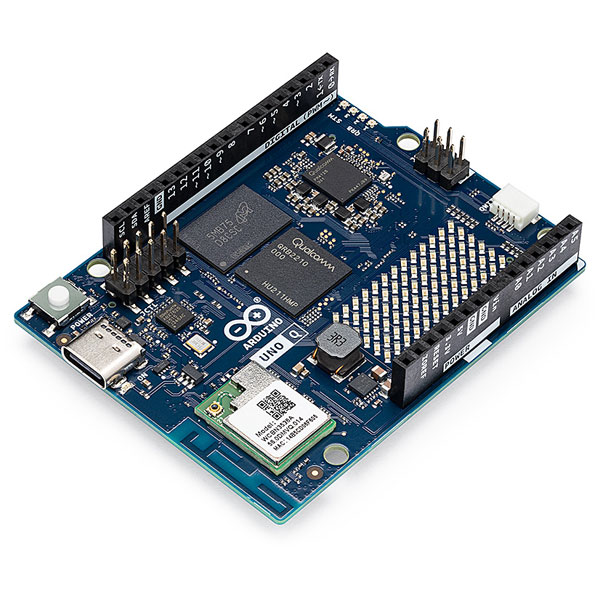 Buy now — 2GB
Arduino UNO Q 4GB
Double the memory, double the ambition. Built for projects that demand more.
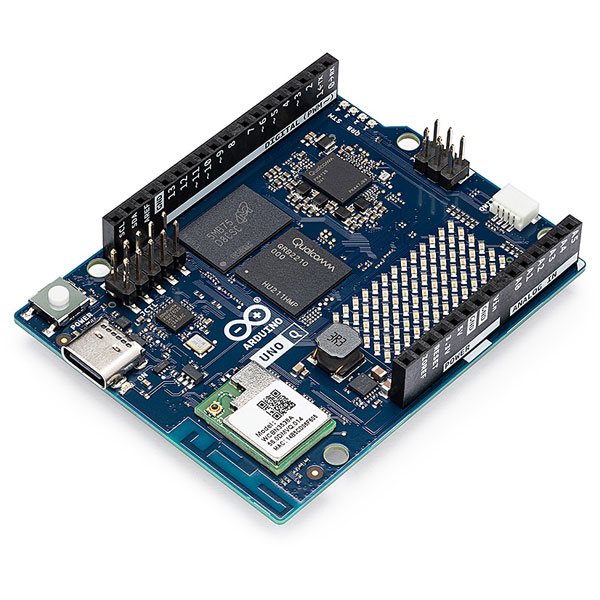 Buy now — 4GB
Exploring edge AI for your operations?
See how the Arduino UNO Q fits your use case, from proof-of-concept to full deployment.
Speak to an expert


 {{SessionBasket.ItemCount }}
