We use cookies on our website to ensure you get the best possible experience – they allow us to tailor content specifically to you, analyse our website to help make improvements, and display ads that are applicable to you across other websites. If you’re happy with this, please select “Allow all", or personalise the cookies you allow with “Manage”. Clicking on “Reject non-essential” will remove these cookies, but the site may not function to its best abilities. For more information, please visit our cookie policy
Five specs that actually matter when choosing a hand-held multimeter (and three that don’t)
Published on 12 March 26
Hand-held multimeters vary enormously in quality, reliability and safety - but the differences aren’t always obvious from a spec sheet.
Manufacturers often highlight large display counts, extensive measurement modes or cosmetic design features. In practice, engineers and maintenance teams rely on a smaller group of specifications that directly affect measurement accuracy, operator safety and long-term durability.
Drawing on typical field applications in industrial maintenance and electrical troubleshooting, this guide focuses on the five specifications that genuinely influence performance, followed by three commonly promoted features that are often less important in real-world use.
Five specs that actually matter when choosing a hand-held multimeter
1. Measurement accuracy (and what “counts” actually mean)
Accuracy is one of the most important specifications on a multimeter - but it’s often misunderstood.
True measurement accuracy depends on three factors:
Basic DC accuracy (expressed as % of reading + counts)
Resolution (often described as counts, e.g. 4,000, 6,000 or 20,000)
Stability over temperature and time
For most professional applications, a good hand-held multimeter will typically offer:
±0.5% basic DC accuracy or better
6,000 counts or higher resolution
True RMS capability for AC measurements
Counts determine how finely a measurement can be displayed. For example, a 6,000-count meter can display values up to 5,999 before changing range.
Higher counts can be helpful when measuring low-level voltages, currents, or small resistance changes, such as during circuit diagnostics or sensor testing. However, once you reach around 6,000–10,000 counts, the practical benefit in most field work becomes incremental.
Accuracy, however, always matters - especially when validating power supplies, troubleshooting control circuits, or verifying commissioning measurements.
2. Safety category rating (CAT II, CAT III, CAT IV)
The CAT safety rating is arguably the most important specification on any multimeter.
Defined under IEC 61010, these categories describe how well a meter can withstand transient voltage spikes that occur in different parts of an electrical system.
Typical categories include:
CAT II – Plug-in appliances and low-energy circuits
CAT III – Distribution panels, industrial equipment and building wiring
CAT IV – Utility connections, service entrances and outdoor installations
In industrial environments, most engineers and electricians require at least:
CAT III 600V, or
CAT III 1000V
This rating is critical because high-energy transients can occur when switching motors, transformers or large inductive loads. A meter without adequate protection may fail under these conditions.
For maintenance teams working on distribution panels or plant equipment, the CAT rating is not simply a specification - it’s a primary safety feature.
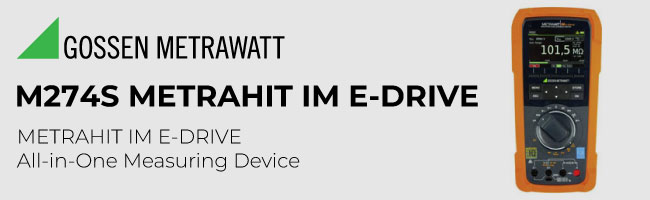
A suitable choice would be Gossen Metrawatt’s M274S, a high‑performance handheld multimeter engineered for work in demanding industrial environments. It combines CAT III 1000 V and CAT IV 600 V safety ratings with excellent measurement precision, making it suitable for tasks ranging from panel diagnostics to plant‑level electrical maintenance.
3. Input protection (fuses, MOVs and PTC devices)
Another key difference between professional and entry-level multimeters is internal input protection.
Well-designed meters include multiple protection layers to prevent catastrophic failure if the meter is used incorrectly.
These protections are essential in situations such as accidentally measuring voltage while the meter is set to current mode - one of the most common user errors.
Professional-grade meters are designed so that even under misuse, they fail safely rather than violently.
For procurement teams evaluating equipment for electrical maintenance staff, this is a critical safety consideration.
4. True RMS measurement
Many engineers assume all multimeters measure True RMS - but this is not always the case.
Basic multimeters often use average responding measurement, which assumes a clean sinusoidal waveform. This works well for standard mains power but becomes inaccurate when waveforms are distorted.
True RMS measurement is important when working with:
Variable frequency drives (VFDs)
Pulse width modulation (PWM) signals
Switch-mode power supplies
Industrial motor control systems
These environments generate non-sinusoidal waveforms, where average responding meters can produce significant measurement errors.
In modern automation and industrial facilities, True RMS capability is increasingly essential for reliable readings.
5. Build quality and durability
Multimeters used in engineering and maintenance rarely fail because of measurement limitations.
They fail because they are dropped, exposed to dust or moisture, or repeatedly transported in toolboxes and service kits.
Good mechanical design significantly extends the lifespan of a meter in daily field use.
For organisations equipping maintenance teams, a robust meter can remain reliable for many years of service, reducing replacement costs and improving measurement consistency.
Engineer-approved multimeters
Three specs that often matter less than people think
1. Extremely high display counts (40,000+)
Very high display counts can look impressive on a specification sheet.
In practice, the jump from 6,000 counts to 40,000 counts rarely changes everyday measurement tasks such as:
Checking mains voltage
Verifying continuity
Diagnosing simple circuit faults
Higher counts can benefit laboratory measurements or precision electronics work, but for most field diagnostics the difference is minimal.
2. Dozens of measurement modes
Modern multimeters may advertise extensive measurement capabilities, including:
Temperature measurement
Duty cycle
Frequency
Capacitance
Diode testing
Microamp ranges
Low-impedance voltage modes
While these functions can occasionally be useful, many engineers primarily rely on just a few core measurements:
Voltage
Continuity
Resistance
Current (less frequently)
For many applications, reliable core measurements are more valuable than a long list of rarely used functions.
3. Large colour displays
Large backlit displays can improve visibility, but advanced colour screens are not always necessary.
For many users, readability in different lighting conditions is more important than screen complexity.
Focus on the specifications that affect real-world performance
When choosing a hand-held multimeter for engineering, industrial maintenance or electrical diagnostics, the most important factors are those that influence measurement reliability, operator safety and long-term durability.
The five specifications that typically matter most are:
Measurement accuracy and resolution
Appropriate CAT safety rating
Robust input protection design
True RMS measurement capability
Strong build quality and environmental durability
Other features, such as extremely high display counts or extensive measurement modes, may be useful in certain scenarios but generally play a smaller role in everyday field work.
By focusing on the specifications that genuinely affect performance, engineers and procurement teams can select multimeters that deliver safe, reliable measurements across a wide range of industrial applications.


 {{SessionBasket.ItemCount }}