Active or passive buzzers?
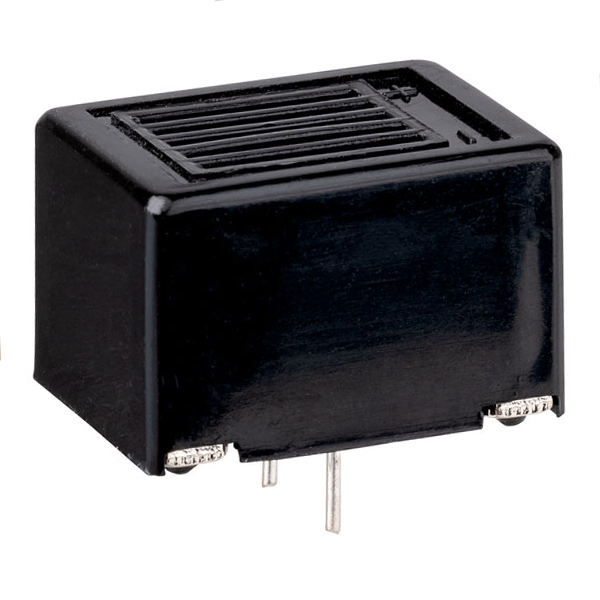
An active buzzer has its own oscillator built in, so you just apply the rated DC voltage and it sounds at a fixed pitch. It's the simplest way to add an alert. A passive buzzer, or transducer, needs a drive signal from your circuit, which takes a little more work but lets you play different tones and patterns. Piezo types are efficient, cope with a wide voltage range and produce a sharp, high-pitched tone. Magnetic types run at lower voltages and produce a fuller sound at lower frequencies. Browse sounders and buzzers.
How loud is loud enough?
Sound output is quoted in decibels at a set distance, often 10cm or 30cm, so check the distance before comparing two parts. Every 6dB is a doubling of sound pressure, and people perceive a 10dB increase as roughly twice as loud. A buzzer is loudest at its resonant frequency, so a passive transducer driven at the frequency on its datasheet will sound far louder than one driven off-resonance. For machine alarms that have to be heard over a factory floor, look at beacons and sounders instead.
Speakers in a product
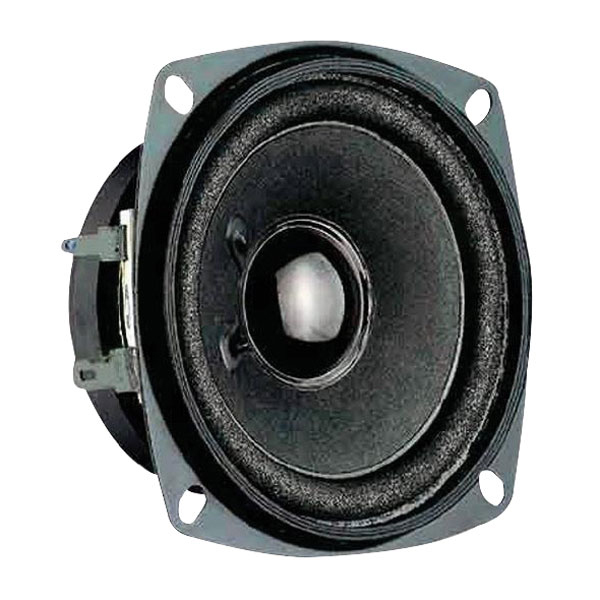
Small speakers are chosen by impedance (commonly 4Ω or 8Ω), power rating and size. Match the impedance to your amplifier, and give the speaker a sealed space or baffle behind it, because a bare speaker loses most of its bass. Mylar cones resist moisture better than paper, which is worth having in outdoor or humid equipment.
Microphones
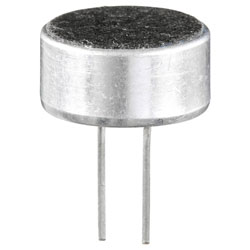
Electret condenser microphones are cheap, small and sensitive, and need a small bias voltage through a resistor to work. MEMS microphones are tinier still and suit compact boards, often with a digital output. Omnidirectional types pick up sound from all around, while directional types reject noise from the sides and rear. For complete microphone systems for rooms and lecture theatres, see microphone systems.
R-TECH buzzers and sounders
Our own R-TECH brand covers electromechanical parts for industrial professionals, including a range of buzzers and sounders that's easy to overlook. R-TECH parts go through the same evaluation as the branded lines we carry, and they're a dependable, cost-effective choice for panels, products and teaching projects alike.
Audio component questions
Can I drive a buzzer straight from a microcontroller pin?
Small active piezo buzzers that draw very little current often can, but check the datasheet against the pin's current limit. Magnetic buzzers draw more and should be driven through a transistor, with a diode across the coil to absorb the voltage spike when it switches off.
Why is my buzzer so quiet?
It's usually one of three things: a passive transducer driven away from its resonant frequency, a supply voltage below the rating, or a mounting that muffles the sound outlet. Mount it with the opening clear and drive it as the datasheet recommends.
Are there waterproof sounders?
Yes. Sealed sounders with an IP rating suit outdoor equipment, vehicles and washdown areas. Check the rating covers the conditions it'll face.
What happens if I use the wrong speaker impedance?
A speaker with lower impedance than the amplifier is rated for makes the amplifier work harder and run hot, and it can fail. Higher impedance is safe but gives less volume.
Does an electret microphone have a polarity?
Yes. The terminal connected to the metal case is ground, and the other carries the signal and bias. Reversed, it won't work properly.


 {{SessionBasket.ItemCount }}