

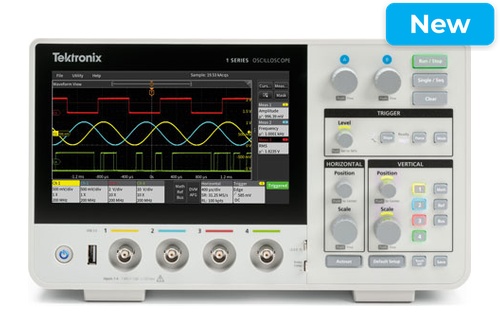
Bandwidth, sample rate and channel count still matter. But in a teaching lab, the bigger question is how well an oscilloscope helps students learn. The new Tektronix DPO1 Series (1 Series) is built around that idea, and it's available now from Rapid Electronics, in stock for same-day UK despatch.
12-bit
vertical resolution
200 MHz
maximum bandwidth
1.25 GS/s
sample rate
10M
points per channel
More than a spec sheet: what teaching labs really need
For decades, oscilloscopes have been compared on the same handful of numbers: bandwidth, sample rate, memory depth and channel count. They're still important, but in education they only tell part of the story.
Electronics labs today face very different pressures:
- Cohorts are bigger
- Practical teaching time is tighter
- Embedded systems are more complex
- Lab space and equipment budgets are limited, but universities still need to prepare students for industry
So the question isn't just "What can this oscilloscope measure?" It's "How well does it help students learn?"
Less time on the controls, more time on the concepts
Ask any electronics lecturer where lab time goes, and circuit theory is rarely the answer. Much of it goes on helping students find their way around unfamiliar instruments: menus, controls, triggering and measurement functions. That's especially true in first-year modules and multidisciplinary STEM courses, where students arrive with very different levels of confidence.
Students don't come to university to learn oscilloscopes. They learn oscilloscopes to understand electronics.
The DPO1 is designed with that in mind. A 7" capacitive touchscreen, a simplified front panel and an interface that's consistent across the wider Tektronix oscilloscope range mean students get comfortable quickly. That leaves more of the session for what really matters, like signal integrity, timing, filtering and circuit behaviour.
Designed for teaching
Education controls: teach the theory, not the shortcut
Modern scopes can automate almost any measurement at the touch of a button. That's great for efficiency, but it can skip the learning.
The DPO1 lets lecturers switch off Autoset, automatic measurements and cursors, so students work out frequency, amplitude and timing by hand before moving on to automated workflows. You decide how much help the instrument gives.
Built for flexible lab spaces
Oscilloscopes have traditionally lived on a fixed bench. But many engineering departments now use flexible, shared spaces for collaborative and multidisciplinary project work.
The DPO1 has a compact footprint, a built-in carry handle and VESA mounting, so it can go on monitor arms, mobile trolleys, desk mounts or walls. The equipment moves to where the learning is happening.
Beyond the bench: software and remote access
Engineering doesn't stop when a waveform appears on screen. The DPO1 works with TekScope PC analysis software, Python drivers, eScope remote access and KickStart software.
Students can analyse, automate and share their measurements in a way that mirrors professional engineering practice.
DPO1 Series key specifications
| Specification | DPO1 Series |
|---|---|
| Analogue channels | 2 (DPO1xx2) or 4 (DPO1xx4) |
| Bandwidth | 50 MHz, 70 MHz, 100 MHz or 200 MHz |
| Max sample rate | 1.25 GS/s |
| Record length | 10M samples per channel |
| Vertical resolution | 12-bit |
| Trigger types | Edge, pulse width, runt, timeout, rise/fall |
| Protocol decode | I2C, SPI, UART |
| DVM / counter | 5-digit DVM, 7-digit frequency counter |
| Signal generator | 25 MHz AFG (S models only) |
| Display | 7" or greater capacitive touchscreen |
| Mounting | VESA compatible, integrated carry handle |
| Software | TekScope, Python drivers, eScope remote access, KickStart |
The DPO1 in universities and colleges
The DPO1 Series is built for undergraduate teaching and project work:
First-year and teaching labs
The touchscreen and education controls help students build confidence and core measurement skills in electronic and electrical engineering and physics.
Final-year and research projects
12-bit resolution, a 10M-point record length, FFT, advanced maths, mask testing and Bode plots make it a capable bench instrument.
Embedded systems courses
I2C, SPI and UART decoding helps students debug the microcontroller designs used in automotive, industrial automation, energy and consumer electronics.
T Levels
Colleges delivering the Engineering and Manufacturing T Level can give learners hands-on experience of industry-standard test equipment.
DPO1 Series FAQs for educators
What is the Tektronix DPO1 Series?
The DPO1 Series, also called the Tektronix 1 Series, is an entry-level digital oscilloscope range with 2 or 4 channels, bandwidths from 50 MHz to 200 MHz and 12-bit vertical resolution.
Can lecturers turn off Autoset and automatic measurements?
Yes. The DPO1's education controls let lecturers disable Autoset, automatic measurements and cursors, so students make measurements by hand and learn the principles behind them.
Which DPO1 model is best for a teaching lab?
For first-year and introductory labs, a 2-channel 50 MHz or 70 MHz model covers most practicals. For embedded systems, power electronics or research work, a 4-channel 100 MHz or 200 MHz model gives more headroom.
Does the DPO1 have a built-in signal generator?
Yes, S models include a 25 MHz arbitrary function generator (AFG) with basic waveforms and modulation.
Can students use the DPO1 to debug microcontroller projects?
Yes. The DPO1 decodes I2C, SPI and UART, common serial protocols on microcontroller boards, so students can see and debug the communication between devices.
Is the DPO1 suitable for university research projects?
Yes. 12-bit resolution, a 10M-point record length per channel and analysis tools including FFT, advanced maths, mask testing and Bode plots make it a capable bench instrument for final-year and postgraduate projects.