Spanners are among the most widely used hand tools in engineering, maintenance and mechanical work. Whether tightening fasteners on industrial machinery, assembling equipment or carrying out vehicle repairs, the right spanner allows technicians to apply controlled torque to nuts and bolts safely and efficiently.
Although the tool itself is simple, there are many different spanner types, each designed for specific tasks, access conditions and torque requirements. Understanding how spanners work - and how to choose the right spanner set - helps engineers and technicians select tools that improve efficiency and reduce the risk of damaging fasteners.
This guide explains how spanners work, the most common types including ratchet spanners and adjustable spanners and the key factors to consider when selecting a spanner set for professional use.
What is a spanner?
A spanner is a hand tool designed to grip and turn fasteners such as nuts and bolts. The tool fits around the fastener head and allows the user to apply torque, tightening or loosening the fastener as needed.
Spanners are commonly used across many industries, including:
- Automotive repair
- Mechanical engineering
- Construction
- Industrial maintenance
- Manufacturing assembly
The basic function of all spanners is the same: convert hand force into rotational torque to move a threaded fastener.
Different designs exist because fasteners may be located in tight spaces, require high torque or need to be accessed quickly during repetitive tasks.
How spanners work: grip, torque and fasteners
Spanners work by gripping the flat sides of a fastener head, typically hexagonal in shape. When force is applied to the handle, torque is transferred through the spanner to rotate the fastener.
The amount of torque that can be applied depends on several factors:
- Contact area with the fastener
- Length of the handle (leverage)
- Material strength of the tool
For example, ring spanners surround the fastener head, providing full contact with multiple sides and reducing the risk of slipping under high torque.
In contrast, open-ended spanners grip two opposite sides of a bolt, which allows faster placement on the fastener but provides less contact area.
The design of the spanner therefore determines:
- How much torque it can safely apply
- How easily it can access tight spaces
- How likely it is to slip or round off the fastener
Common spanner types
There are many spanner types, each suited to different applications. The most common designs are used daily in workshops, factories and maintenance environments.
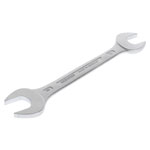
Open-ended spanner
An open-ended spanner has U-shaped jaws on both ends of the tool. These jaws fit around two opposite sides of a nut or bolt.
This design allows the open-ended spanner to slide onto a fastener from the side, which is useful when the bolt cannot be accessed from above.
Typical uses include:
- Mechanical repairs
- Plumbing fittings
- Machinery maintenance
Many open-ended spanners are angled by around 15 degrees, allowing the user to reposition the tool easily when working in tight spaces.

Ring spanner
A ring spanner has a closed circular head that fits completely over a nut or bolt.
Because the ring surrounds the fastener, it provides greater contact and grip, making it ideal for applying higher torque or loosening stubborn fasteners.
Ring spanners are commonly used in:
- Automotive repair
- Engineering workshops
- Industrial maintenance
Many ring spanners use a 12-point profile, allowing the tool to be positioned more easily on the fastener.
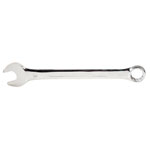
Combination spanner
A combination spanner includes both an open end and a ring end on the same tool, with both ends sized for the same fastener.
This design offers the advantages of both types:
- The open end allows quick positioning on the fastener
- The ring end allows higher torque and a more secure grip
Combination spanners are widely used because they provide versatility in a single tool.
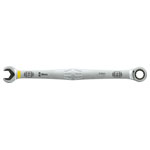
Ratchet spanner
A ratchet spanner includes a ratcheting mechanism inside the ring head. This mechanism allows the spanner to turn a fastener in one direction while freely rotating in the opposite direction.
Internally, the ratchet mechanism uses a gear and spring-loaded pawls to allow movement in one direction while locking in the other.
This design provides several advantages:
- Faster tightening and loosening
- No need to remove and reposition the spanner
- Improved efficiency in confined spaces
Because of this, ratchet spanners are popular for automotive work, assembly lines and maintenance tasks where fasteners must be tightened repeatedly.
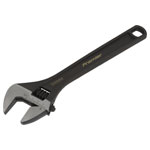
Adjustable spanner
An adjustable spanner has a movable jaw that can be adjusted using a worm screw mechanism. This allows the spanner to fit a wide range of bolt sizes without needing multiple tools.
Key features include:
- Adjustable jaw opening
- Worm gear adjustment mechanism
- Compatibility with different fastener sizes
Adjustable spanners are particularly useful for:
- General maintenance
- Plumbing work
- Installation and repair tasks
However, because they grip fewer sides of the fastener than a ring spanner, they are usually less suitable for very high torque applications.
What is the difference between an open-ended spanner and a Ring Spanner?
The most common distinction in spanner types is the head design. An Open-Ended Spanner features U-shaped jaws that slide onto a nut from the side, making it ideal for long threaded rods where a closed loop cannot fit. A Ring Spanner (or box-end) completely encircles the fastener, providing contact on all six corners of a hex bolt. This significantly increases the torque capacity and reduces the risk of the tool slipping or "rounding off" the fastener.
Why is a Combination Spanner the industry standard for workshops?
The Combination Spanner is arguably the most versatile of all spanner types. It features an open-ended head on one side and a ring head on the other, both sized for the same fastener. This allows a technician to use the open end for "fast-running" a nut onto a bolt and then flip the tool to use the ring end for the final, high-torque tightening. In 2026, premium combination spanners often feature an offset on the ring end to provide essential knuckle clearance on flat surfaces.
Choosing a spanner set
For most workshops and maintenance teams, purchasing a spanner set is the most practical option.
A typical spanner set includes a range of sizes to match common fastener dimensions. Standard metric sets often range from 6 mm to 32 mm, covering the majority of bolts used in machinery and equipment.
When selecting a spanner set, consider the following factors:
Size range
Ensure the set includes the sizes required for the equipment or machinery being serviced.
Metric vs imperial
Industrial equipment may use either measurement system, so it may be necessary to keep both types available.
Tool design
Combination spanners are often the most versatile choice, while ratchet spanner sets are preferred for repetitive work.
Storage
Many sets include tool rolls or trays to keep the spanners organised and easy to transport.
Having a complete spanner set ensures technicians always have the correct tool size available, reducing the risk of damaging fasteners with poorly fitting tools.
What are the essential size ranges for a professional spanner set?
When choosing a spanner set, the range should match your industry’s standard fasteners. For most general industrial and automotive work, a metric set spanning 6mm to 32mm is the standard. However, precision electronics may require "Mini" sets starting at 4mm, while heavy-duty plant maintenance often requires specialised sets that go up to 50mm or beyond. Buying a set ensures you have the "intermediate" sizes (like 11mm or 16mm) that are often missing from basic toolkits but are common in modern European machinery.
Materials and build quality
The durability of spanners depends heavily on the materials and manufacturing processes used.
Most professional spanners are made from chrome vanadium steel, a strong alloy that provides high strength, durability and corrosion resistance.
High-quality spanners are typically:
- Drop forged for strength
- Heat treated for durability
- Chrome plated to resist corrosion
These manufacturing processes ensure the tool can withstand repeated use and high torque without deforming or breaking.
Common applications for spanners
Spanners are used in a wide range of professional environments.
Automotive repair
Mechanics use spanners to tighten or loosen bolts on engines, suspension systems and other vehicle components.
Mechanical engineering
Spanners are essential for assembling machinery and equipment.
Construction
Fasteners used in structural assemblies and equipment installation are often tightened using spanners.
Industrial maintenance
Maintenance technicians rely on spanners to service pumps, motors, conveyors and other plant equipment.
While the basic function remains the same, spanner uses vary significantly depending on the industry. For example, a heavy-duty adjustable spanner is a staple of facility maintenance, while a precision open-ended spanner is more common in fine-tuned mechanical engineering.
Choose your next spanner
Although simple in design, spanners remain one of the most essential tools in engineering, manufacturing and maintenance work.
By understanding the differences between common spanner types such as open-ended, ring, adjustable and ratchet spanners, technicians can choose the right tool for each task. Selecting a well-made spanner set with the correct size range and durable materials ensures reliable performance and long service life.
Whether used for everyday maintenance or complex mechanical work, the right spanner makes fastening tasks safer, faster and more efficient.



 {{SessionBasket.ItemCount }}
