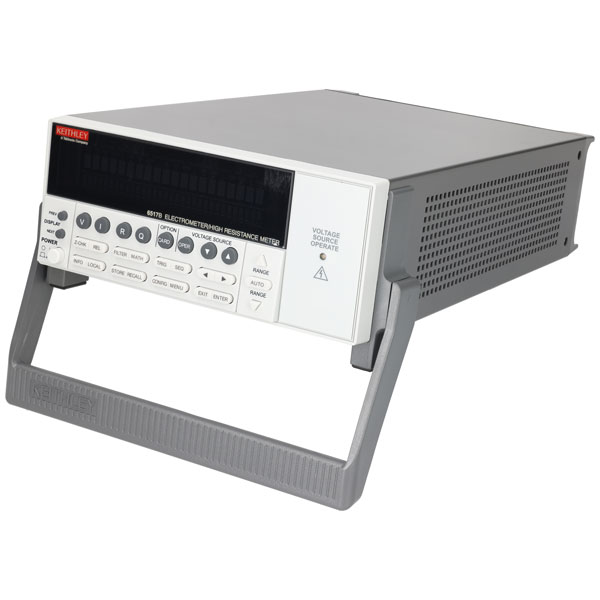
Some measurements are forgiving. Others hinge on the sixth decimal place, a current smaller than a picoamp, or a reading that has to come out the same on Friday as it did on Monday. That's Keithley territory.
Most engineers meet the brand through Keithley bench multimeters, and it's easy to see why. The 2110 is an honest 5½-digit meter for everyday bench work at a sensible price. The DMM6500 steps up to 6½ digits on a touchscreen, with 15 measurement functions and a built-in digitiser that catches the transients a standard meter misses. Working on battery-powered or IoT designs? The 7½-digit DMM7510 follows a device from its microamp sleep current right up to a 1A transmit burst, so you'll finally know where the battery life is going. And if one channel isn't enough, the DAQ6510 puts the same 6½-digit accuracy behind up to 80 channels, turning a meter into a full data acquisition and logging system for thermal and environmental testing.
Then there are the SourceMeter source measure units, which do the job of a power supply and a meter in one box. Rather than juggling two instruments and a tangle of leads, the 2450 sources voltage or current and measures the result on the same terminals. That makes plotting I-V curves on LEDs, diodes and solar cells a doddle. Need more headroom? The 2470 goes all the way to 1,100V.
For the really small stuff, the 6485 picoammeter reads currents down to 10fA, and the 6487 adds a 500V source for insulation resistance testing. Just remember that at these levels the cable matters as much as the meter, and we'll happily help you get both right.
Our team is trained on the Keithley range through our technical partnership, so if you're not sure which instrument fits the job, just ask. Equipping a university lab? You can order through the NWUPC framework under LAB3152NW.

 {{SessionBasket.ItemCount }}