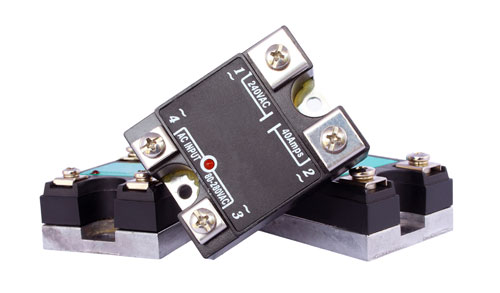
Relays are essential components in electrical systems, enabling control of high-power circuits using low-power signals. For decades, mechanical relays dominated this space, but modern electronics demand faster, more reliable, and maintenance-free solutions. Enter solid-state relays (SSRs), which are quickly replacing traditional mechanical relays in industrial applications like temperature control, commercial applications like in HVAC systems, and mechanical relays are replaced in consumer applications like controlling household appliances and the audio industry.
What is a solid state relay?
A solid-state relay is an electronic switching device that uses semiconductor components instead of moving parts to control electrical loads. Unlike mechanical relays, SSRs rely on components such as thyristors, triacs, or transistors to switch circuits on and off. This design eliminates physical contacts, making SSRs more durable and efficient.
How solid state relays work
The operation of an SSR is straightforward:
- A low-voltage control signal activates the relay.
- Instead of closing a physical contact, the SSR uses an optocoupler and semiconductor switch to transfer the signal.
- The load circuit is switched electronically, ensuring fast response times and zero mechanical wear.
This electronic switching mechanism is what gives SSRs their superior performance compared to mechanical relays.
Why mechanical relays are becoming obsolete
Mechanical relays have served well for decades, but they come with limitations:
- Slow switching speed due to moving contacts.
- Wear and tear from physical movement, leading to shorter lifespan.
- Noise and arcing during operation.
- Maintenance requirements in high-cycle applications.
Modern systems, especially those in automation, IoT and renewable energy, require components that can handle high switching frequencies and long operational life without downtime.
Key advantages of solid state relays
- High reliability: No moving parts means no mechanical failure.
- Fast switching: Ideal for applications requiring rapid on/off cycles.
- Silent operation: No clicking sounds, unlike mechanical relays.
- Long lifespan: Can handle millions of cycles without degradation.
- Resistance to shock and vibration: Perfect for industrial environments.
- Low maintenance: Reduces downtime and operational costs.
Solid state relay common applications in modern electronics
Solid-state relays are widely used in:
Industrial automation
Controlling motors, heaters and pumps.
HVAC systems
Silent switching for compressors and fans
Renewable energy
Managing solar inverters and battery systems
Medical equipment
Ensuring reliable, noise-free operation
Consumer electronics
Power control in smart home devices
How to choose the right Solid State Relay
When selecting an SSR, consider:
- Load type: AC or DC load requirements.
- Current and voltage ratings: Match the relay to your system specs.
- Heat dissipation: SSRs generate heat; proper cooling is essential.
- Switching speed: High-speed SSRs for data or automation systems.
- Isolation requirements: Optocoupler-based SSRs for signal integrity.
Solid states relays vs mechanical relay: which should you use?
| Feature |
Solid State Relay |
Mechanical Relay |
| Switching Speed |
Very Fast |
Slow |
| Lifespan |
Millions of cycles |
Limited cycles |
| Noise |
Silent |
Audible click |
| Maintenance |
Minimal |
Regular |
| Cost |
Higher upfront |
Lower upfront |
While SSRs may cost more initially, their long-term reliability and reduced maintenance make them the better choice for modern systems.
How do solid state relays improve switching speed and performance?
SSRs utilise semiconductor switching, allowing them to toggle states in microseconds compared to the millisecond response times of mechanical versions. This near-instantaneous switching is critical for high-frequency applications like pulse width modulation (PWM) and precise temperature control where mechanical lag would reduce system efficiency.
How does a solid state relay reduce electromagnetic interference (EMI)?
Many SSRs feature "zero-voltage switching" capabilities, meaning they only turn on when the AC load voltage is at the zero-crossing point. This significantly reduces the surge of current and the resulting electromagnetic interference (EMI) and radio frequency interference (RFI) that typically occurs when mechanical contacts spark during a transition.
Future trends in relay technology
As industries move toward smart automation, IoT integration and renewable energy, SSRs will continue to evolve:
- Higher efficiency designs for energy savings.
- Integrated diagnostics for predictive maintenance.
- Compact, high-power SSRs for electric vehicles and smart grids.
Ready to upgrade your systems?
Solid-state relays offer unmatched reliability, speed, and durability for today’s demanding applications. If you’re still using mechanical relays, now is the time to make the switch. Explore our SSR selection guide and start building safer, smarter systems today.
Browse full range

 {{SessionBasket.ItemCount }}