The Raspberry Pi has been designed to be a catalyst towards cheap, accessible, programmable computers. It is a credit-card sized computer that has USB inputs for devices such as mouse and keyboard and analogue or digital outputs for monitors or TVs. The Raspberry Pi is a capable computer that will perform many of the functions that a desktop PC will, like spreadsheets, word processing and games and will also play high definition video.
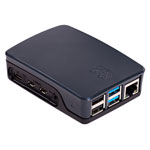
The Model B of Raspberry Pi has 512MB RAM, 2x USB port and an Ethernet port as well as an audio jack, an RCA video and a HDMI output, GPIO pins, micro USB power connection and an SD card slot. The assembly measures 85.6 x 56 x 21mm, excluding a small overlap for the SD card and connectors.
At the heart of the Raspberry Pi is the System-On-Chip (SoC) which is a Broadcom BCM2835. The SoC contains an ARM1176JZFS with floating point that runs at 700MHz and a Videocore 4 GPU. The GPU will playback BlueRay quality video with the graphics capabilities being roughly equivalent to Xbox levels of performance.
Overall, the Raspberry Pi has the real world performance equivalent of a 300MHz Pentium 2 but with the Raspberry Pi delivering vastly superior graphics.
- Ideal as a system to use for learning programming
- The GPU provides Open GL ES 2.0, hardware-accelerated OpenVG, and 1080p30 H.264 high-profile decode
- The GPU is capable of 1Gpixel/s, 1.5Gtexel/s or 24 GFLOPs of general purpose computing
- Features texture filtering and DMA infrastructures
- Device boots from a SD card but a USB HD can 'take over' after the initial boot
- Add any supported USB microphone for audio in
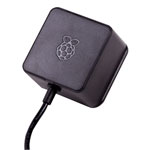
- Powered by 5v micro USB
- SD cards up to 32GB
- Includes 10/100 wired Ethernet


 {{SessionBasket.ItemCount }}