Surface Mount LEDs (SMD LEDs) are PCB-mounted light sources selected when board area, thermal budget, assembly repeatability, and luminous output must be balanced within defined electrical and mechanical constraints. Unlike through-hole LEDs, SMD packages rely entirely on PCB copper, solder joints and layout quality to manage heat and ensure long-term reliability.
As a result, SMD LED selection is not just a packaging choice - it directly affects junction temperature, lumen maintenance, assembly yield, and field lifetime. These components are widely used in control electronics, lighting assemblies, automotive subsystems, and display products where size, efficiency and manufacturability are tightly coupled.
Operating characteristics & system-level behaviour
SMD LEDs are current-driven semiconductor devices whose performance is governed primarily by junction temperature rather than nominal electrical ratings.
Key behavioural characteristics include:
- Non-linear current–lumen relationship at higher drive currents
- Temperature-dependent efficiency and colour shift
- Accelerated lumen depreciation when operated near maximum ratings
- Reliance on PCB copper area and thermal vias for heat removal
Designing with SMD LEDs therefore requires attention to thermal paths, drive current margins, and ambient operating conditions, not just forward voltage.
SMD LED specifications, package construction & technical parameters
- Package format: Flat, low-profile housings designed for automated pick-and-place and reflow soldering
- Die & phosphor system: Semiconductor dies with phosphor conversion layers for white and tunable outputs
- Standard size codes: 3014, 3528, 5050, and 5630 (dimensions in tenths of a millimetre)
- Electrical characteristics: Typical forward voltage range of ~2.0–3.6 V depending on colour and chemistry
- Thermal interface: Integrated thermal pads transferring heat directly into PCB copper
- Colour options: Single colour, RGB, and tunable white configurations
- Service life: Often specified beyond 50,000 hours, assuming correct thermal management and derating
SMD LED types & package formats
3014 SMD LEDs
- Typical use: High-density linear lighting and backlighting where uniformity is critical
- Engineering strengths: Very small footprint enables tight LED spacing
- Design constraints: Limited thermal mass; sensitive to reflow profile and pad design
- Indicative parameters: 3.0 × 1.4 mm package; ~20 mA nominal drive current
 Browse 3014
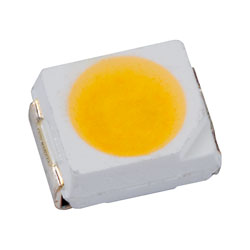
3528 SMD LEDs
- Typical use: Indicator lighting, low-power strips, display backlighting
- Engineering strengths: Predictable electrical behaviour; easy to integrate
- Design constraints: Single-colour only; limited luminous output per package
- Indicative parameters: 3.5 × 2.8 mm package; ~20 mA nominal drive current
 Browse 3528
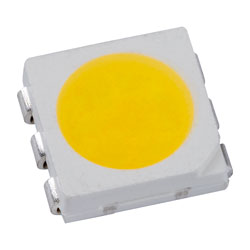
5050 SMD LEDs
- Typical use: RGB lighting, signage, decorative and dynamic lighting systems
- Engineering strengths: Supports multiple dies in a single package for RGB mixing
- Design constraints: Higher thermal load; requires copper pours and vias beneath the thermal pad
- Indicative parameters: 5.0 × 5.0 mm package; up to ~60 mA per channel
 Browse 5050
5630 SMD LEDs
- Typical use: High-brightness commercial and industrial lighting
- Engineering strengths: High luminous flux per device
- Design constraints: Junction temperature rises rapidly without adequate heat spreading
- Indicative parameters: 5.6 × 3.0 mm package; ~150 mA drive current
- Thermal management: The Primary Design Limitation
 Browse 5630
What do the standard SMD LED size codes (like 5050) actually mean?
The four-digit code refers to the physical dimensions of the LED package in millimeters (length x width). For example, a 5050 LED measures 5.0mm x 5.0mm. Larger packages generally offer more surface area for heat dissipation, allowing for higher drive currents and brightness.
For SMD LEDs, thermal design is the single biggest factor in determining lifetime. Yes, they may look similar at first glance, but each package has its own unique thermal characteristics and design considerations.
Key considerations:
- Copper pour area under thermal pad
- Thermal vias connecting to internal or rear copper layers
- Aluminium-core PCBs for high-power applications
- Ambient temperature and enclosure airflow
Insufficient heat removal leads to:
- Reduced luminous output
- Colour shift
- Early lumen depreciation
- Premature device failure
- Assembly & Manufacturing Considerations
Because SMD LEDs are fully dependent on solder joints for both electrical and thermal performance:
- Reflow profiles must remain within manufacturer limits
- Pad geometry directly affects thermal resistance
- Polarity errors remain a common assembly defect
- Double reflow cycles can reduce long-term reliability if not controlled
For production designs, assembly process capability should be considered during LED selection, not after.
Why is junction temperature (Tj) more important than ambient temperature?
The junction temperature (Tj) is the heat at the actual semiconductor die, which is always higher than the surrounding air. If Tj exceeds the manufacturer's limit (often 100°C to 125°C), the LED will suffer from immediate efficiency loss, colour shifting toward the blue spectrum, and a drastic reduction in its L70 lifetime (the time it takes to lose 30% of its brightness).
While ambient temperature (Ta) refers to the surrounding air, it is a poor indicator of LED health because it does not account for the "thermal resistance" of the PCB; an LED can operate in a cool room but still fail if the heat cannot escape the junction.
Selection guidance for engineers & specifiers
When specifying SMD LEDs, evaluate:
- Required luminous flux at operating temperature
- Maximum allowable junction temperature
- Available PCB area for thermal spreading
- Drive current derating across temperature range
- Colour stability and binning requirements
- Compatibility with constant-current LED drivers
Avoid specifying devices solely based on maximum brightness or headline lifetime claims.
Applications in context
SMD LEDs are typically integrated into:
- Status indicators on control PCBs
- Backlighting behind diffusers or light guides
- Linear lighting assemblies on metal-core boards
- RGB lighting modules driven by PWM or current control
In each case, performance depends as much on mechanical and thermal integration as on the LED itself.
Standards & Compliance
Common compliance considerations include:
- CE marking for electrical safety and EMC
- RoHS compliance for restricted substances
- UL recognition in regulated markets
- IEC performance standards for electronic components
Compliance supports both regulatory acceptance and predictable long-term behaviour.
Reliability & Common Failure Modes
Typical causes of field failure include:
- Overdriving without thermal derating
- Insufficient PCB copper under thermal pads
- Enclosed housings with no airflow
- ESD damage during handling or assembly
Designing with margin significantly improves system robustness.
How do thermal pads and thermal vias prevent SMD LED failure?
Unlike traditional bulbs, SMD LEDs emit heat backward into the PCB rather than forward as infrared radiation. To manage this, engineers use thermal pads on the bottom of the LED soldered to large copper pours and thermal vias (tiny plated holes) that "wick" heat away to the opposite side of the board or internal metal layers, effectively turning the PCB into a heatsink.
Summary
Surface Mount LEDs are highly capable light sources, but their performance is governed by thermal management, drive conditions, and PCB design quality rather than package size alone. By selecting appropriate SMD LED formats, controlling junction temperature, and aligning electrical drive with real operating conditions, engineers and procurement teams can achieve reliable, long-life illumination across industrial, commercial, and electronic systems.
Browse all SMDs


 {{SessionBasket.ItemCount }}
