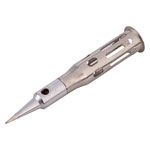
Soldering quality depends on more than iron wattage or digital temperature control. The soldering tip is the critical interface between the heating element and the joint, directly affecting heat transfer, wetting performance, joint integrity and component safety.
In professional electronics, manufacturing, repair and prototyping environments, selecting the correct tip and maintaining it properly reduces rework, prevents pad lifting and significantly extends tool life. This guide explains how soldering tips are constructed, how different shapes perform in real applications, recommended working temperatures and proven maintenance practices used across engineering and trade settings.
Why soldering iron tips matter
A soldering tip determines:
- Heat transfer efficiency
- Thermal recovery speed
- Contact surface area
- Accessibility to components
- Oxidation resistance
- Service life
Even a high-quality soldering station will underperform if paired with the wrong tip geometry or a degraded surface. Inconsistent heating is a primary cause of cold joints, excessive dwell times and component damage.
Soldering tip construction: materials & durability
Modern soldering tips are engineered with layered construction to balance thermal conductivity and wear resistance.
Typical structure:
- Copper core – provides excellent heat conductivity
- Iron plating – prevents rapid erosion from molten solder
- Nickel/chrome coating – protects non-working surfaces from oxidation
- Tinned working surface – promotes proper solder wetting
Pure copper tips dissolve quickly in solder. Iron plating provides durability while retaining effective heat transfer. When the iron layer becomes worn or breached, copper exposure accelerates failure and causes uneven heating.
Common signs of plating failure include pitting, cavities or visible copper coloration.
Soldering tip shapes & practical applications
Selecting the correct tip shape improves efficiency and reduces the need to raise temperatures unnecessarily.
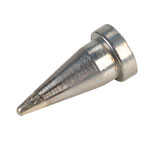
Conical (B-Type)
Best for: Fine-pitch ICs, precision PCB work, tight access areas
Offers high accuracy but limited thermal mass. Suitable for light-duty and delicate soldering tasks.
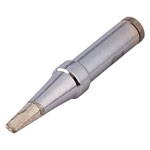
Chisel (D-Type)
Best for: General electronics, through-hole components, connectors
Provides excellent heat transfer due to its flat surface area. This is the most versatile and widely used tip shape in professional environments.
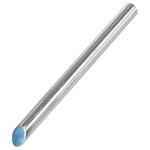
Bevel (C-Type)
Best for: Drag soldering, larger pads, moderate thermal loads
The curved surface holds more solder and distributes heat efficiently across pads.
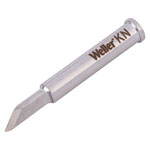
Knife (K-Type)
Best for: SMD rework, removing solder bridges, component removal
The angled edge allows controlled sweeping and precise rework operations.
Needle / Micro Tips
Best for: Micro soldering, compact consumer electronics, smartphone repair
Prioritises precision over heat capacity. Not suited for heavy joints.
Tapered Tips
Best for: Mixed-density boards, fine joints, controlled‑heat work
Tapered geometry offers balanced heat transfer for varied soldering tasks effectively.
Practical rule:
For most electronics applications, a medium chisel tip will handle the majority of soldering tasks effectively.
Recommended soldering temperatures
Temperature selection should match the alloy, joint size and thermal load. Excessive heat accelerates oxidation and reduces tip life, while insufficient heat leads to poor wetting and weak joints.
Leaded solder (Sn63/Pb37)
- Standard PCB work: 315–350°C
- Larger joints: 370–390°C
Lead-free solder (SAC305, SnCu)
- Standard PCB work: 350–380°C
- Larger thermal loads: 400–430°C
Lead-free alloys require higher working temperatures and benefit from tips with greater thermal mass. If you can't decide what solder to go for, here are some of our favourites below, including our own brand, R-TECH, as well as various other notable soldering brands:
Key temperature factors
- Tip geometry and mass
- Copper area of PCB pads
- Component heat sensitivity
- Iron wattage and thermal recovery
- Ambient airflow or heat sinking
Best practice:
Use the lowest temperature that achieves a clean, fully wetted joint within 1–2 seconds of contact.
Professional tip maintenance practices
Proper maintenance significantly extends tip lifespan and preserves performance consistency.
1. Always keep the tip tinned
+
A thin layer of solder protects the iron plating from oxidation.
Tin the tip before storage and immediately after cleaning.
2. Use appropriate cleaning methods
+
Recommended accessories:
- Brass wool or brass shavings
- Dry tip cleaning systems
Use with caution:
- Damp sponge (can cause thermal shock)
Avoid entirely:
- Abrasive paper
- Files
- Scraping tools
Abrasives remove protective plating and permanently damage the tip.
3. Avoid excessive idle heat
+
Extended exposure at high temperatures accelerates oxidation. Use sleep mode where available or reduce temperature during pauses in work.
4. Use higher temperatures only when necessary
+
Operating continuously above 400–450°C dramatically shortens tip life. Reserve higher settings for heavy copper planes or large connectors.
5. Recovering oxidised tips
+
If solder no longer wets the surface:
- Lower temperature slightly
- Use tip tinner/activator
- Immediately re-tin the surface
If plating has eroded, replacement is required. Damaged plating cannot be restored.
When to replace a soldering tip
Replace the tip if you observe:
- Pitting or deep cavities
- Solder de-wetting
- Uneven heat transfer
- Visible copper exposure
- Significant surface scratching
Continuing to use a worn tip increases the risk of PCB pad damage, extended dwell times and unreliable joints.
Final thoughts
The soldering iron tip plays a decisive role in joint quality, efficiency and equipment longevity. Selecting the appropriate geometry, operating within suitable temperature ranges and following disciplined maintenance practices ensures consistent, professional results across electronics assembly, repair and production environments.
In high-reliability applications, attention to tip selection and care is not optional - it's fundamental to achieving repeatable, standards-compliant soldering performance.



 {{SessionBasket.ItemCount }}