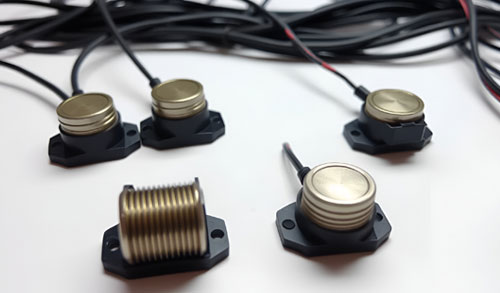
Automation is transforming industries, and at the heart of this revolution are sensors that make machines smarter and safer. Among these, proximity sensors play a critical role by detecting objects without physical contact. From manufacturing lines to robotics and smart devices, proximity sensors enable precision, efficiency, and safety. This guide explains how they work, the different types available, and why they’re essential in modern automation.
What is a proximity sensor?
A proximity sensor is a device that detects the presence or absence of an object, or its distance, without direct contact. Unlike mechanical switches, proximity sensors use electromagnetic fields or light to sense objects, making them ideal for environments where durability and speed are crucial.
Key characteristics:
- Non-contact detection
- High reliability in harsh conditions
- Fast response time
How do proximity sensors work?
Proximity sensors operate by emitting a signal, such as an electromagnetic field or infrared light, and monitoring changes when an object enters the detection zone. When the sensor detects a disturbance in its field, it triggers an output signal.
Detection principles include:
- Electromagnetic induction: Used in inductive sensors for detecting metal objects.
- Capacitance changes: Used in capacitive sensors for detecting non-metallic materials.
- Infrared reflection: Used in optical sensors for detecting objects based on light reflection.
- Ultrasonic waves: Used in ultrasonic sensors for measuring distance and detecting objects regardless of material.
Types of proximity sensors
Different technologies suit different applications. Here are the main types:
Inductive Proximity Sensors
- Detect metallic objects using electromagnetic fields.
- Common in industrial automation for machine safety and part detection.
Capacitive Proximity Sensors
- Detects both metallic and non-metallic objects, including liquids and powders.
- Ideal for packaging and material handling.
Infrared (Photoelectric) Proximity Sensors
- Use light reflection to detect objects.
- Common in robotics and smart devices for precise object detection.
Ultrasonic Proximity Sensors
- Emit sound waves to measure distance.
- Useful for level measurement and obstacle detection in robotics.
Inductive vs capacitive sensors for metal detection
When selecting between inductive and capacitive proximity sensors for metal detection, the primary difference lies in their specificity. While both can detect metal, inductive sensors are specialised "metal-only" detectors, whereas capacitive sensors are "all-material" detectors.
How does a photoelectric proximity sensor work?
A photoelectric sensor operates by emitting a beam of light (usually infrared or visible) toward a target. It detects the object when the light beam is either broken or reflected back to a receiver, allowing for long-range detection that other proximity sensors cannot achieve.
What are the advantages of using ultrasonic proximity sensors in automation?
Ultrasonic sensors are highly effective in harsh environments because they are unaffected by dust, smoke, or light interference. Their ability to measure the "time-of-flight" of sound waves allows them to provide precise distance measurements, not just a simple "present or absent" signal.
Applications in modern automation
Proximity sensors are everywhere in automated systems:
🏭
Manufacturing: Detecting parts on assembly lines, ensuring correct positioning.
🤖
Robotics: Obstacle detection and collision avoidance.
📱
Smart devices: Gesture control and object detection in consumer electronics.
🚨
Safety systems: Preventing accidents by detecting human presence near machinery.
What is the role of proximity sensors in the Internet of Things (IoT)?
Within IoT frameworks, proximity sensors act as the "eyes" of a smart system, gathering real-time data on asset movement and occupancy. This data is transmitted to the cloud to trigger automated workflows, such as lighting control in smart buildings or inventory tracking in automated warehouses.
Benefits of proximity sensors
- Improved efficiency: Faster detection speeds reduce downtime.
- Enhanced Safety: Non-contact sensing prevents wear and tear and protects operators.
- Versatility: Works in harsh environments, including dust, moisture, and vibration.
Integration tips
When integrating proximity sensors into automation systems:
- Choose the right type: Match sensor technology to material and environment.
- Consider range and sensitivity: Ensure the sensor meets your detection distance requirements.
- Check compatibility: Confirm the sensor works with your PLC or SBC communication protocols.
Future trends
Proximity sensors are evolving with Industry 4.0:
- Smart sensors: Equipped with IoT connectivity for real-time monitoring.
- AI-driven systems: Predictive maintenance using sensor data.
- Miniaturisation: Smaller sensors for compact devices and wearables.
Ready to automate?
Proximity sensors are the unsung heroes of modern automation. They enable machines to “see” without touching, improving efficiency, safety, and reliability. Whether you’re designing a robotic arm, automating a production line, or building smart devices, proximity sensors are essential for success.
Browse full range

 {{SessionBasket.ItemCount }}