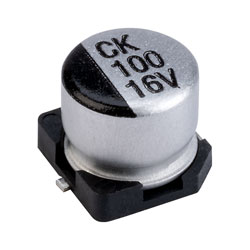
Capacitors are everywhere, from your smartphone to your car’s electrical system. They play a crucial role in storing and releasing energy, making them essential components in modern electronics and power systems. In this guide, we’ll break down what capacitors are, how they work, the different types available, and where you’ll find them in everyday applications.
What is a capacitor?
A capacitor is an electronic component that stores electrical energy in an electric field. Unlike a battery, which stores energy chemically, a capacitor stores energy physically between two conductive plates separated by an insulating material called a dielectric.
Key functions of capacitors:
- Smooth out voltage fluctuations in circuits
- Provide quick bursts of energy when needed
- Filter signals in electronic devices
How does a capacitor work?
Capacitors operate on a simple principle: they charge and discharge electrical energy.
- Charging: When connected to a power source, electrons accumulate on one plate, creating an electric field.
- Discharging: When the circuit demands energy, the stored charge flows back, stabilizing voltage or powering components.
This ability to release energy quickly makes capacitors ideal for applications where fast response is critical.
Types of Capacitors:
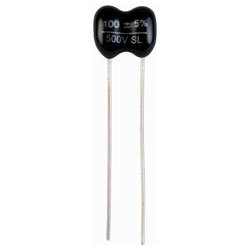
Mica Capacitors
Mica capacitors are extremely stable and are typically used in RF and high-frequency circuits where accuracy and durability are critical.
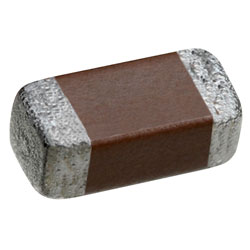
Ceramic capacitors
Ceramic capacitors are small, inexpensive, and widely used in high-frequency applications. They are non-polarized, allowing for flexible installation in various electronic circuits.
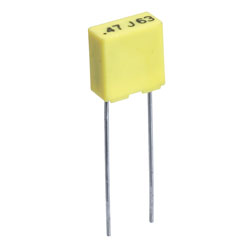
Film capacitors
Film capacitors are known for their excellent stability and reliability. They are commonly used in audio systems and precision circuits where consistent performance is essential.
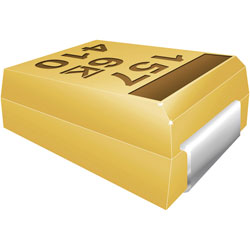
Tantalum Capacitors
Tantalum capacitors provide a compact size combined with high capacitance, making them perfect for space-constrained electronics such as smartphones and portable devices.
Electrolytic capacitors
Electrolytic capacitors offer high capacitance values, making them ideal for power supply circuits where large energy storage is needed. They are polarized components, which means they must be installed in the correct orientation to function properly.
When should I use ceramic vs film capacitors?
Choose ceramic capacitors for high-frequency applications and general-purpose decoupling due to their low cost and compact size. Opt for film capacitors when your circuit requires high precision, low "noise," and long-term stability, such as in high-end audio equipment or power film applications.
Common applications of capacitors
Capacitors are used in a wide range of devices and systems:
- Consumer Electronics: Smartphones, TVs, laptops
- Power Supply Systems: Voltage regulation and filtering
- Automotive & EVs: Energy storage for hybrid and electric vehicles
- Renewable Energy: Solar and wind power systems for energy smoothing
Capacitors vs batteries
While both store energy, they serve different purposes:
- Capacitors: Quick charge/discharge, short-term energy storage
- Batteries: Long-term energy storage, slower charge/discharge
Capacitors are ideal for stabilising voltage and providing short bursts of power, while batteries are better for sustained energy supply.
How does a capacitor store energy vs a battery?
While batteries rely on chemical reactions to create a flow of electrons, capacitors store energy physically as an electrostatic field. This allows capacitors to charge and discharge almost instantaneously, whereas batteries provide a slower, sustained release of power over a longer duration.
Safety and maintenance
Capacitors can hold a charge even after power is disconnected, so always discharge them before handling.
Signs of failure include:
- Bulging or leaking casing
- Burn marks or unusual heat
- Circuit malfunction
Future trends
Capacitors are evolving with technology:
- Electric Vehicles: High-capacity capacitors for regenerative braking
- IoT Devices: Miniaturised capacitors for compact electronics
- Energy Storage: Advanced materials for higher efficiency
How do capacitors improve renewable energy systems?
In solar and wind power, capacitors act as a buffer to handle the intermittency of natural energy sources. They smooth the "choppy" output generated by fluctuating wind speeds or passing clouds, ensuring a steady, high-quality stream of electricity enters the power grid.
Final thoughts
Capacitors may seem simple, but they’re vital for modern electronics and energy systems. Whether you’re designing a circuit or troubleshooting a device, understanding how capacitors work and where to use them - can make all the difference.
Browse full range

 {{SessionBasket.ItemCount }}