Choosing the dielectric
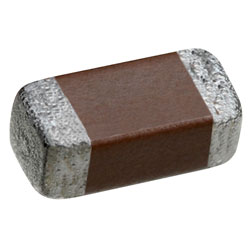
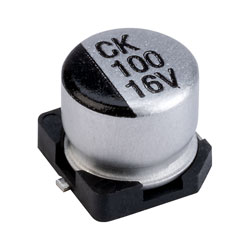
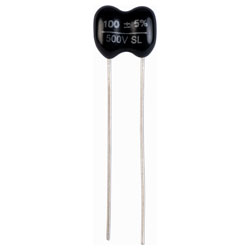
Aluminium electrolytic capacitors give you a lot of capacitance for the money, which makes them the standard for bulk smoothing on power rails. Polymer types do the same job with much lower ESR and a longer life, which suits switching regulators. Ceramic capacitors are small, cheap and ideal for decoupling, but there's a catch: high-value X7R and Y5V parts lose a good part of their capacitance once a DC voltage is applied, so check the datasheet's DC bias curve. C0G (NP0) ceramics stay stable and suit timing and filter circuits.
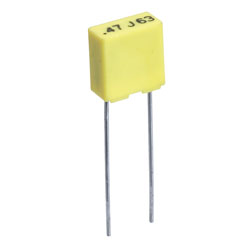
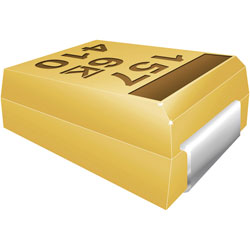
Tantalum packs plenty of capacitance into a small case but needs generous voltage headroom, especially where there's a surge at power-up. Film capacitors keep their value for years. Polyester is the economical general-purpose choice, while polypropylene has lower losses and handles pulses and AC well, so it's the one for audio, snubbers and mains applications.
Voltage and temperature: where lifetime is decided
An electrolytic capacitor's life is quoted in hours at its maximum temperature, and as a rule of thumb it roughly doubles for every 10°C cooler it runs. A 105°C part in a warm enclosure will comfortably outlast an 85°C one. Ripple current heats the capacitor from inside, so check the ripple rating on power supply designs, and leave some headroom on the voltage rating rather than running at the limit.
Suppression and motor run capacitors
Capacitors connected across the mains must be safety-rated. Class X capacitors go between line and neutral, and class Y capacitors go between line and earth, where they're designed to fail safely without creating a shock hazard. Never substitute an ordinary capacitor in either position. For complete EMC filtering, see filters and suppression. Motor run capacitors are a separate family again, rated for continuous AC duty on single-phase electric motors. Replace like for like on capacitance and voltage.
TruComponents equivalents
For many everyday values, our own TruComponents capacitors are matched to the branded parts on capacitance, voltage, temperature rating and size, usually for less. Every one is tested before it's added to the range, and where there's a direct equivalent you'll find it shown alongside the branded part, so you can compare and decide. Complete the circuit with resistors and inductors from the same passives range.
Capacitor questions
Can I replace a capacitor with a higher voltage rating?
Generally, yes, as long as the capacitance and type match and it physically fits. The exception is some switching regulators, which rely on a specific ESR for stability, so check the regulator's datasheet before changing type.
Which way round does an electrolytic capacitor go?
The stripe on the body marks the negative lead, which is also the shorter one on a new part. Fitted backwards, an electrolytic can overheat and vent, so double-check before powering up.
What does 104 mean on a ceramic capacitor?
It's a code in picofarads: the first two digits are the value and the third is the number of zeros. 104 is 10 followed by four zeros, or 100,000pF, which is 100nF.
Is it safe to touch a capacitor in powered-down equipment?
Not always. Large capacitors, especially in power supplies, can hold a dangerous charge long after the equipment is switched off. Discharge them through a suitable resistor and check with a meter before handling.
Can I buy capacitor kits from Rapid?
Yes. Mixed kits cover the common values in one box, which is handy for prototyping, repairs and teaching.


 {{SessionBasket.ItemCount }}